
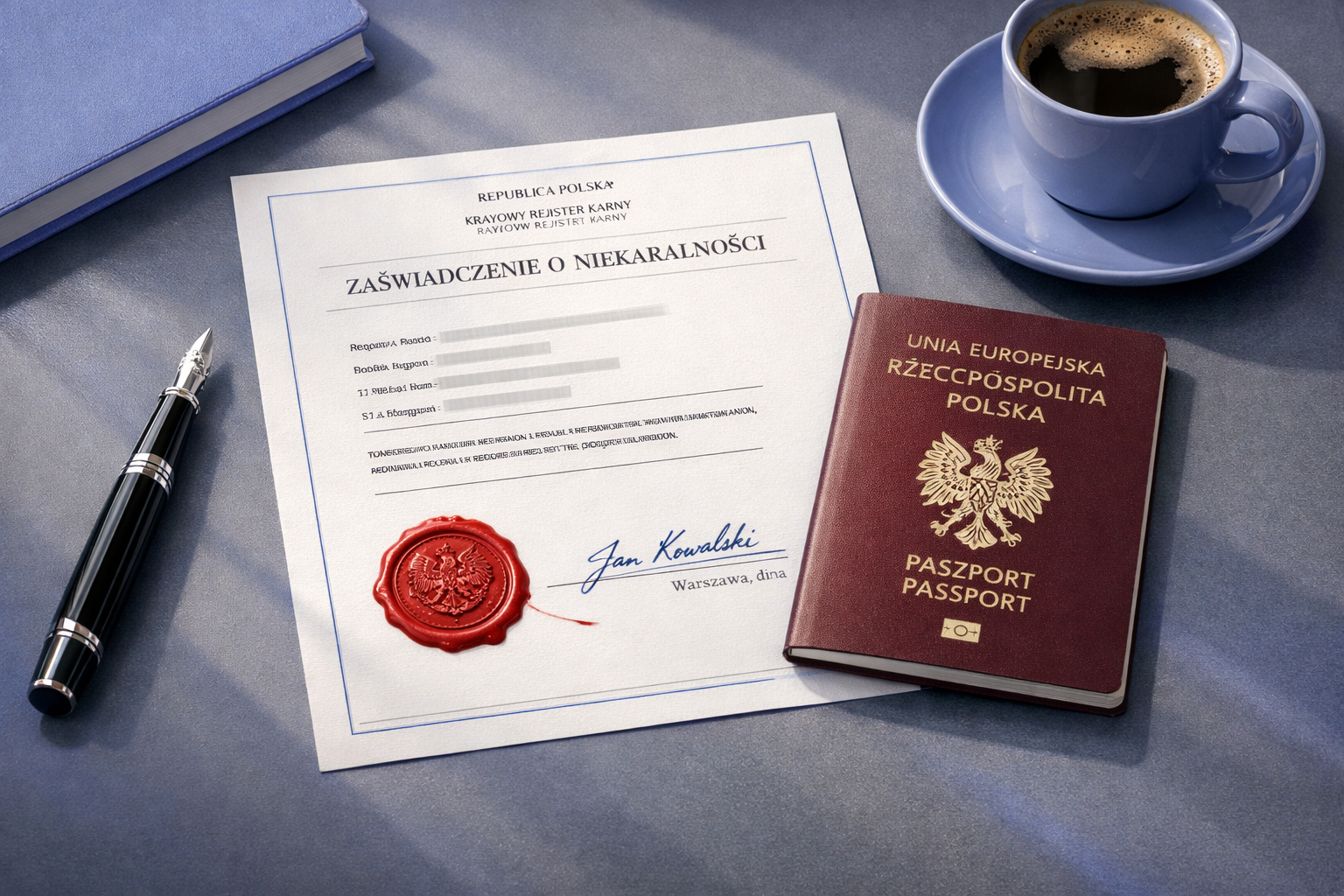
The Ultimate Guide: Polish Police Clearance Legalization vs. Apostille
Moving from Poland to a non-EU country is complex. Consequently, it requires navigating strict bureaucratic rules. Are you an expat moving to the Middle East? Or perhaps an HR team managing global relocations with partners like Lex Corporation? In either case, securing a work visa depends on one critical document. Specifically, you need a Polish background check (Zaświadczenie o niekaralności).
However, how do you make a National Criminal Register (KRK) document valid abroad? If you move to a non-Hague country, a standard Poland MSZ Apostille is not enough.
Therefore, we created this definitive guide. Firstly, it explains the difference between an Apostille and Consular Legalization. Furthermore, you will learn to avoid common rejection traps. (Looking for more tips? Check out the Sworn Translator Warsaw Blog).
What is the Difference Between an Apostille and Legalization?
Basically, the authentication process depends entirely on your destination.
- The Apostille (Hague Convention): For instance, are you moving to a Hague Convention country like the US or UK? If so, the process is simple. Indeed, a single Warsaw Apostille makes the document legally valid. Moreover, the Polish Ministry of Foreign Affairs (MSZ) issues this stamp.
- Consular Legalization (Non-Hague Countries): On the other hand, your destination might be outside the Hague Convention. Examples include Qatar, Vietnam, or Kuwait. Consequently, an Apostille will be rejected. Instead, you must complete a multi-step Consular Legalization. Therefore, you need validation by the MSZ. Afterward, you need a final stamp from the embassy.
The #1 Pitfall: Electronic (e-KRK) vs. Physical Police Clearance
Before you begin, you must have the correct version of your background check. In fact, this is where most applications fail.
Therefore, do not download the e-KRK. Even though an electronic XML file is valid inside Poland, foreign embassies will strictly reject it. As a result, you cannot print a digital certificate for legalization.
Instead, you must obtain the physical paper version of the KRK directly from the Polish courts via traditional methods. Additionally, this document must feature an original wet-ink signature. Finally, it needs a physical administrative seal.
The 4-Step Consular Legalization Process (How to Do It Right)
Undoubtedly, navigating the full process for a non-Hague country is tricky. Specifically, the sequencing of authentications is critical. Because a single misstep will result in embassy rejection, you must follow this exact sequence:
- Firstly, secure the physical paper document from the National Criminal Register in Poland.
- Secondly, have the document translated by a certified Polish Sworn Translator.
- Thirdly, submit both the original Polish KRK and the sworn translation to the MSZ. Currently, the government fee for standard legalization is 26 PLN per document. Moreover, processing takes 2–4 working days. Thus, the MSZ authenticates the court’s seal and the translator’s signature.
- Finally, submit the dual-legalized bundle to the relevant foreign embassy in Warsaw.
Importantly, document expiration is a major risk. Because many embassies reject a police clearance older than 90 days, you must complete this chain quickly.
Costs, Timelines, and How to Get It Done Faster
Generally, managing this process requires your physical presence in Warsaw. Furthermore, you must navigate government queues. Consequently, the entire timeline usually takes 7 to 15 working days.
However, at Sworn Translator Warsaw, we eliminate this friction. Specifically, we handle the entire legalization chain on your behalf.
Our 100% Remote Workflow:
You do not need to travel to Warsaw. Instead, simply mail your physical documents to us via courier. Subsequently, we will sequence the sworn translations and expedite the MSZ legalization. Finally, we will navigate the embassy and return the fully validated documents directly to your door.
Frequently Asked Questions (FAQ)
Can I use the electronic Polish police clearance (e-KRK) for an Apostille?
No. Because the MSZ strictly requires the physical paper version, printed e-KRK files are rejected. Furthermore, it must have a wet-ink signature and court seal.
Do I need an Apostille or Legalization for my Polish background check?
Basically, it depends on your destination. If you move to a Hague Convention country, you need an Apostille. However, if you move to a non-Hague country, you must undergo Consular Legalization.
Does my sworn translation also need to be legalized?
Yes. Specifically, embassies require you to legalize both documents for non-Hague countries. Therefore, the MSZ must authenticate the translator’s signature first.
How long does it take to legalize a document in Warsaw?
Typically, the MSZ processes documents within 2 to 4 working days. However, you must factor in court retrieval and translations. Consequently, the entire process takes 7 to 15 working days.
Contact Sworn Translator Warsaw Today
Are you ready to start your document legalization? We are here to help. Specifically, our expert team guarantees a fast and stress-free process. Furthermore, we provide exact quotes tailored to your destination country.
Therefore, do not let bureaucracy delay your relocation. First, gather your documents. Next, reach out to our specialists. Finally, let us handle the rest.
Get in touch with us right now: Sworn Translator Warsaw