Navigating cross-border corporate mobility or international relocation demands absolute administrative precision. When managing foreign investments, workforce deployments, or personal residency structures, document validity is paramount. Foreign authorities routinely reject unauthenticated documentation, stalling vital corporate transactions. Consequently, expanding operations beyond Poland requires systematic legal verification of domestic records.
Securing a polish apostille represents the definitive mechanism for validating your Polish civil, corporate, or academic documents for international use. Furthermore, the authentication journey often requires specific linguistic certification via a recognized sworn translator in Warsaw. Understanding the interplay between these two administrative procedures prevents costly operational bottlenecks. This professional brief details the exact operational methodologies, judicial requirements, and processing timelines governing global legalizations.
Where can I get an official Polish Apostille stamp for foreign documents?
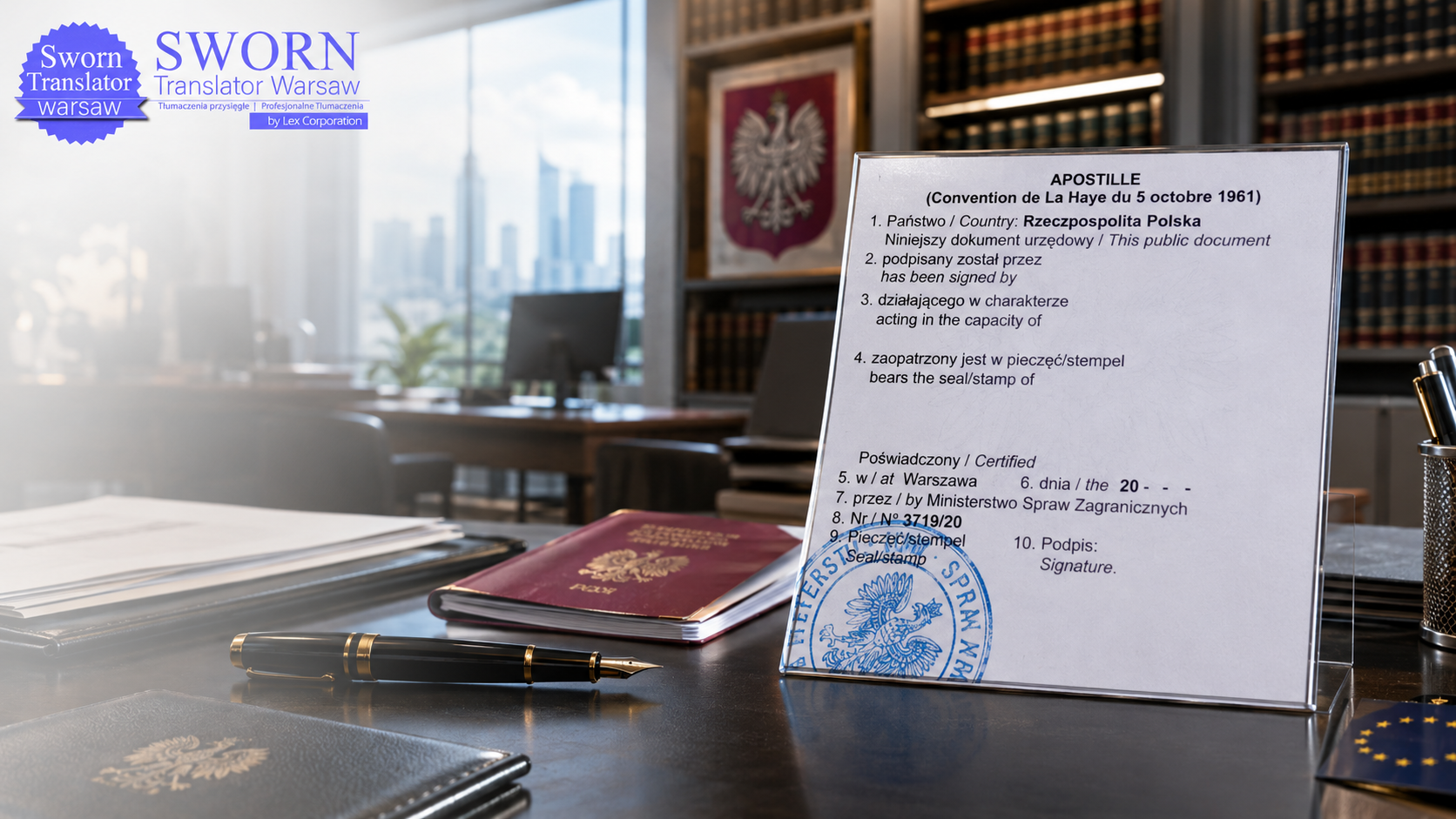
The centralized authority responsible for issuing an official polish apostille is the Ministry of Foreign Affairs (Ministerstwo Spraw Zagranicznych). Located in Warsaw, the Legalization Department directly verifies signatures on public, judicial, and administrative documents. However, specific document classes require preliminary structural authentication before the ministry can apply its official stamp.
For example, academic diplomas require validation from specific educational bodies before submission to the ministry. Similarly, commercial instruments issued by companies listed in the National Court Register (KRS) require initial judicial verification. Navigating these regional departments independently often introduces administrative friction for international enterprises.
| Document Category | Primary Verification Authority | Secondary Legalization Body |
| Civil Status Certificates (Birth, Marriage) | Local Registry Office (USC) | Ministry of Foreign Affairs (MSZ) |
| Corporate Extracts (KRS, NIP, REGON) | Central Registry Court | Ministry of Foreign Affairs (MSZ) |
| Academic Degrees & Transcripts | National Agency for Academic Exchange | Ministry of Foreign Affairs (MSZ) |
| Notarial Deeds & Judgments | Regional District Court (Sąd Okręgowy) | Ministry of Foreign Affairs (MSZ) |
Therefore, corporate entities must map their document types to the correct administrative track before visiting the Warsaw office.
Why do international authorities require both an Apostille and a sworn translation?
International regulatory frameworks operate on strict verification principles. The apostille strictly authenticates the origin of the document. Specifically, it confirms the authenticity of the official signature, the capacity of the signer, and the identity of the seal. It does not, however, validate or translate the internal semantic content of the instrument itself.
Consequently, receiving countries require a clear translation to process the underlying data. To maintain strict evidentiary standards, this translation must be executed by an officially recognized linguist. In Poland, this requires a specialist registered with the Ministry of Justice. A certified translation ensures that foreign courts, banks, and migration agencies receive a flawless linguistic equivalent.
The Mechanism of Legal Equivalency
A standard translation lacks statutory standing before foreign public offices or the Office for Foreigners. A sworn translation carries a unique registration number, formal seal, and statement of legal responsibility. When combined with an authenticating stamp, the document attains universal regulatory compliance across all Hague Convention jurisdictions.
Structural Sequencing Variations
In most regulatory scenarios, the legalizing stamp must be obtained before the translation occurs. This sequence allows the linguist to translate both the core certificate and the authentication stamp text together. However, certain jurisdictions accept translations executed first, followed by an apostille applied to the translator’s signature via the court.
Our multi-disciplinary team of Polish corporate attorneys, certified accountants, and licensed HR compliance specialists handles end-to-end relocation, statutory audits, and market integration pathways under government employment agency license number 34916.
What is the quickest way to verify a Polish certificate for use abroad?
Accelerating the verification loop requires a synchronized approach to regional administrative filings. The fastest pathway utilizes direct corporate submission to the Ministry of Foreign Affairs in Warsaw. This setup bypasses the delays associated with international postal routing or multi-tiered agency queues.
Furthermore, leveraging digital infrastructure can expedite specific preliminary steps. While pure digital printouts are rejected, utilizing the ePUAP Public Infrastructure Access allows for rapid ordering of official physical copies. Once the physical specimens are secured, the formal verification process must follow a strict, non-negotiable sequence.
1.Document Procurement and Pre-Authentication:
Secure the original, wet-ink document from the issuing registry or court. Ensure all institutional seals, signatures, and titles are clearly legible. Submit academic or commercial files to their respective pre-authentication boards to obtain mandatory preliminary stamps.
2.Ministry of Foreign Affairs Submission:.
Present the pre-authenticated instrument to the Ministry of Foreign Affairs Legalization Department in Warsaw. The ministry verifies the signature against its state registry database. Upon confirmation, the authority appends the physical apostille certificate directly to the paper document.
3.Sworn Translation Execution:
Deliver the authenticated document pack to a licensed linguist registered in the state database. The specialist translates the entire structural layout, including the newly attached legalization text. The translator appends their statutory seal, signature, and formal text ledger record.
4.Final Corporate Quality Audit:
Perform a complete compliance check of the finalized dossier against the destination country’s criteria. Verify that all cross-referenced names, registry numbers, and dates match perfectly. The unified document pack is now legally ready for deployment in foreign corporate operations.
Technical Compliance and Administrative Frameworks
Maintaining corporate velocity during cross-border expansions requires close attention to the structural validity of your operational documents. Missing a single seal can invalidate an entire commercial transaction or delay crucial corporate filings. Therefore, establishing a rigorous pre-flight review protocol protects your enterprise from costly delays.
Pre-Submission Compliance Requirements
Before submitting your documentation to the Warsaw authorities, you must ensure that every file meets basic criteria. The following checklist details the key elements that must be verified during your initial internal review:
- Signature Verification: The physical document must display an original, handwritten signature from an authorized official.
- Seal Integrity: All institutional stamps must be distinct, unsmudged, and fully visible across the page boundaries.
- Chronological Validity: Certain records, such as criminal background checks, must be issued within 30 to 90 days of submission.
- State Database Alignment: The signing official must be currently registered within the active Ministry of Foreign Affairs signature verification index.
Administrative Processing Velocity Comparison
Processing speeds vary significantly depending on the submission method and current queue volumes at the regional departments. Understanding these timelines allows your operational managers to plan cross-border deployments with realistic expectations.
In-Person Inquiries at Warsaw MSZ
Direct submission at the Warsaw office provides the fastest resolution. Documents are verified, stamped, and returned within a minimal administrative window. This path requires direct local placement or a designated corporate proxy.
Domestic Postal Route Within Poland
Submitting files via the domestic postal system introduces transit queues. The ministry processes items in the order received. This approach is useful when local presentation is not logistically feasible.
International Diplomatic Channels
Routing documents through foreign consulates or international courier services extends the validation loop. This method involves multiple handoffs between foreign offices and the central ministry in Warsaw.
Common Pitfalls That Delay Global Document Legalization
The most frequent cause of administrative rejection is submitting documents signed with a standard electronic signature. Although valid inside Poland for local filings, these digital signatures lack the physical verification tracking needed for the international treaty framework. To resolve this, you must secure an official wet-ink extract from the central issuing authority.
Furthermore, out-of-date civil documents frequently trigger sudden processing rejections. For example, older birth certificates may lack modern biometric security tracking or updated administrative codes. Consequently, the ministry may reject the document, forcing your team to request fresh copies from the local registry office.
Conclusion
Successfully navigating Polish document legalization requires careful attention to regional administrative workflows and strict formatting rules. Managing this process correctly ensures smooth international operations and protects your organization from bureaucratic delays.
- Centralized Authentication: The Ministry of Foreign Affairs in Warsaw remains the sole authorized issuer of the official legalization stamp.
- Linguistic Validation: International compliance requires a certified translation from a linguist registered with the Ministry of Justice.
- Strict Sequencing: Documents must be properly pre-authenticated before you approach the central ministry for the final stamp.
- Digital Disconnect: Digital signatures require wet-ink validation before they can be legally used in foreign jurisdictions.
For comprehensive support with global mobility, corporate structuring, and cross-border compliance, partner with our expert advisors at the Lex Corporation Main Hub. We provide end-to-end management of complex corporate documentation through our dedicated Legalization and Mobility Hub. Reach out to our specialists via our About Us Institutional Trust Page to secure your international growth pipelines today.
Frequently asked Questions (FAQ)
Q: What is the corporate process for obtaining a polish apostille in Poland?
A: The corporate process requires obtaining an original wet-ink document, securing preliminary departmental certifications if required, and submitting the file to the Ministry of Foreign Affairs in Warsaw. Finally, a certified linguist must translate the entire package for foreign use.
Q: Why is compliance mandatory for international enterprises using Polish records?
A: Compliance ensures that corporate documents are legally recognized by foreign courts, financial institutions, and regulatory registries under the Hague Convention. Without formal authentication, these international entities will reject domestic Polish instruments.
Q: How does the regulatory procedure unfold step by step?
A: The procedure begins with document acquisition and mandatory internal pre-authentication by relevant state agencies. Next, the Ministry of Foreign Affairs appends the legal stamp, followed by a sworn translator applying the necessary linguistic validation seals.
Q: Can this company operational setup be handled completely remotely?
A: Yes, the entire authentication and legalization workflow can be managed remotely by utilizing a designated local corporate proxy in Warsaw. This setup allows international enterprises to secure a polish apostille without sending physical personnel to Poland.
Q: What are the explicit document requirements for successful ministry authentication?
A: Documents must feature original handwritten signatures, clear institutional stamps, and appropriate pre-authentication marks from designated state agencies. The Ministry of Foreign Affairs will reject any printouts that only feature standard digital signatures.
Contact Sworn Translator Warsaw today
Are you ready to start legalizing your documents? We’re here to help. Our team of experts ensures the entire process is quick and stress-free. We also provide accurate quotes tailored directly to your destination country.
So don’t let bureaucracy delay your relocation. First, gather your documents. Then contact our specialists. Finally, let us take care of the rest.
Contact us now: Sworn Translator Warsaw