
Apostille or Legalization: The Ultimate Decision Guide
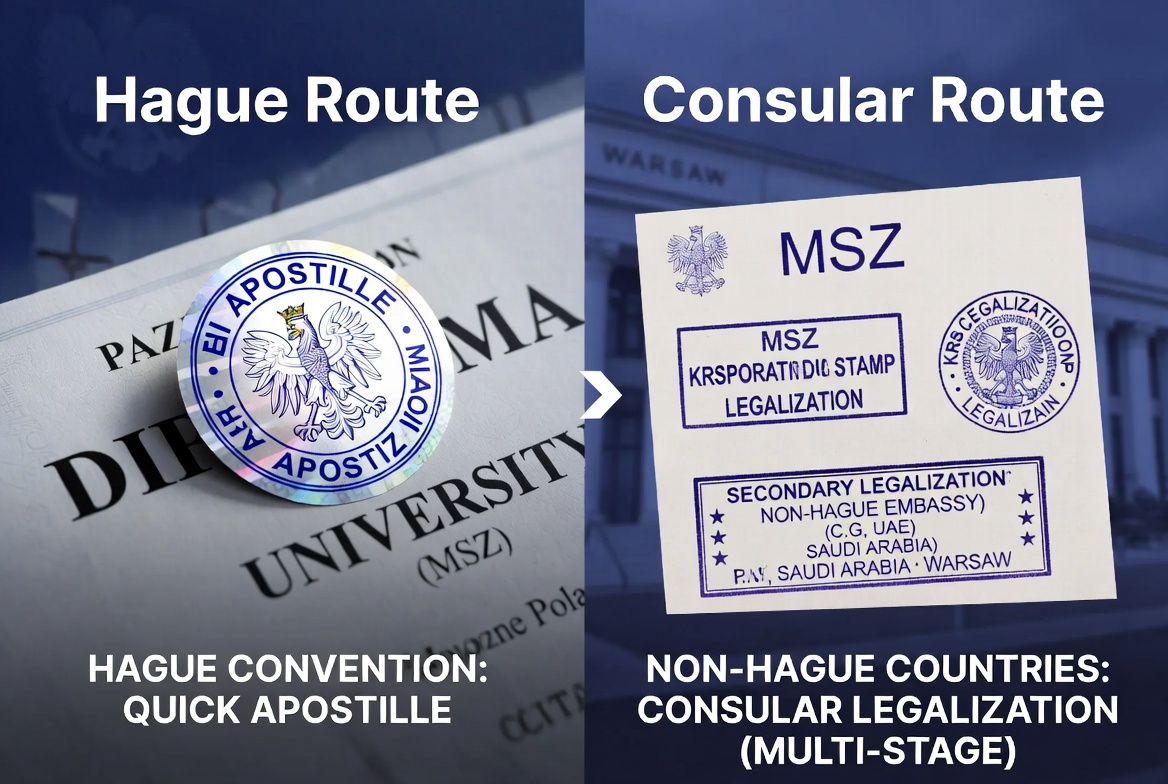
Do you need to use your Polish documents abroad? First, you must determine the correct authentication method. Specifically, you must decide between a Hague Apostille or consular legalisation.
However, choosing the wrong process causes expensive delays. Therefore, we created this guide to help you choose the correct path. Furthermore, this guide explains how to avoid common submission traps.
1. Is Your Destination Country a Hague Member?
First, you must check the status of your destination country. If the country is a member of the 1961 Hague Convention, you need an Apostille.
Conversely, countries that are not members require full consular legalization. For example, countries like the UAE, Saudi Arabia, and China require this multi-stage „superlegalization” process.
2. The Apostille Pipeline (Hague Countries)
An Apostille is a standardized sticker issued by the Ministry of Foreign Affairs (MSZ). Specifically, it validates the authenticity of the signature and the official seal (Lex Corp)
You can complete this process relatively quickly. First, you must secure your physical paper document. Second, you must obtain any mandatory pre-authentications. Finally, you submit the document to the Ministry of Foreign Affairs in Warsaw.
3. The Consular Legalization Pipeline (Non-Hague)
For non-Hague countries, the process is more complex. Specifically, it involves a three-step chain of authority.
First, you obtain the necessary pre-authentications for your specific document. Second, you submit the document to the Polish Ministry of Foreign Affairs for their official legalization stamp. Finally, you must take the document to the Embassy or Consulate of your destination country. There, the consul will verify the Ministry’s seal and add their own final stamp.
4. Critical Submission Traps to Avoid
Do Not Use Electronic Documents
Many applicants make a fatal mistake. They download an electronic background check or court registry printout and submit it. Unfortunately, the Ministry will always reject these digital files. Instead, you must provide a physical paper original bearing a wet-ink signature and a round administrative seal.
Respect the Mandatory Sequencing
You must follow the sequence exactly. For consular legalization, the Ministry of Foreign Affairs must stamp the document first. Afterwards, the Embassy can add their seal. You cannot reverse this order.
Correct Document Naming for Business
Corporate legal departments often search for a „Certificate of Incumbency.” However, in Poland, you must request an Official Extract from the KRS (Odpis z KRS). Always use this term when ordering your documents from the court.
How to Manage the Process Remotely
Fortunately, you can complete both Apostille and consular legalization workflows 100% remotely. For example, our team at Sworn Translator Warsaw manages every administrative tier for you.
First, you grant us a written Power of Attorney (upoważnienie). Next, our team physically routes your files through the regional courts and the Ministry. Subsequently, we coordinate the final Embassy attestation if your destination requires it. Finally, we execute the certified translations and ship the completed folders straight to your door. For context on document types, you can also read our guide on how to get your Poland PCC background check.
Get Started Today
Do you want to avoid bureaucratic traps and save valuable time? Instead of managing these complex sequences alone, contact Sworn Translator Warsaw today. Alternatively, send us a message through our secure web form to receive a transparent flat-rate quote immediately.