
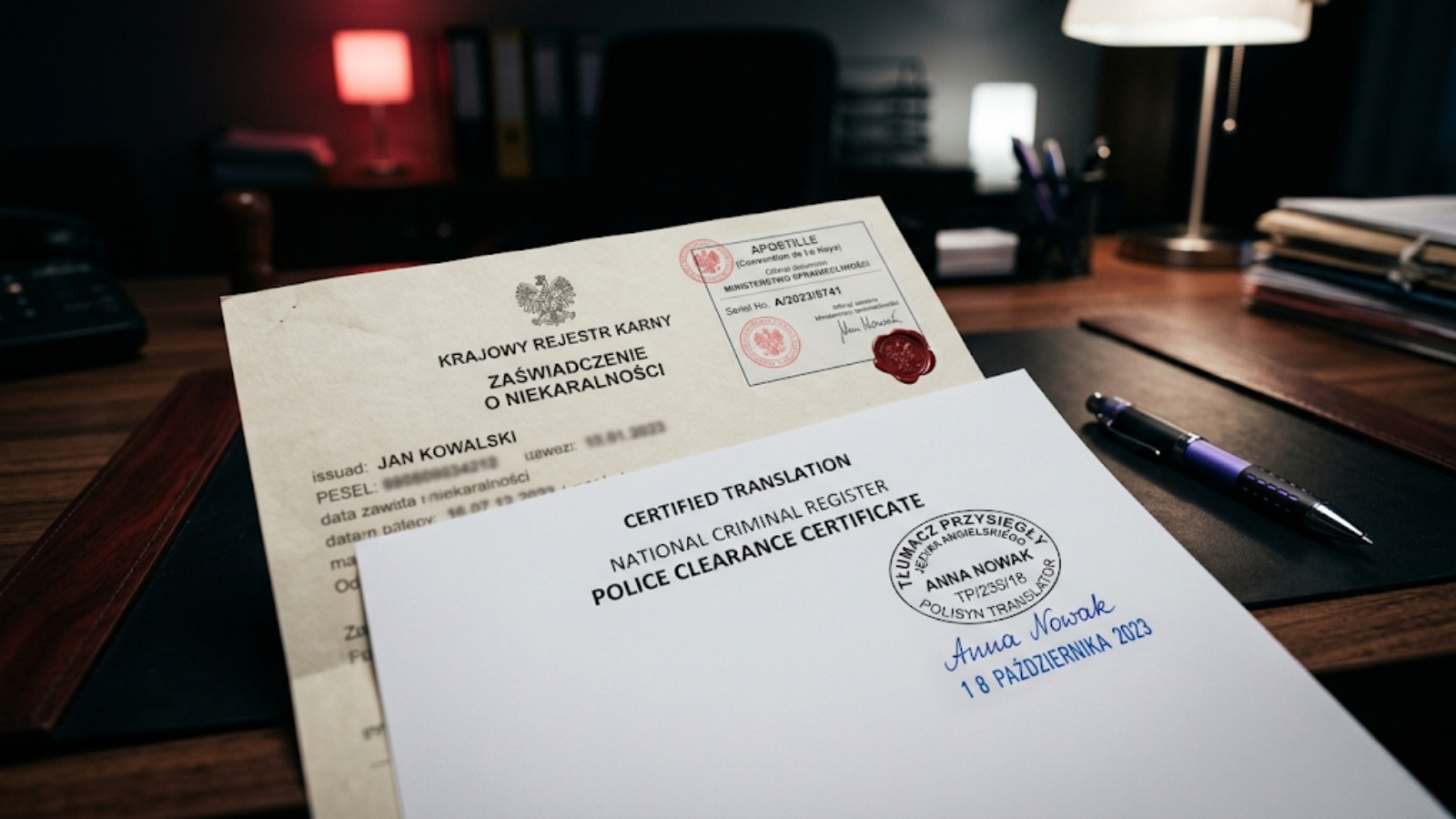
Police Clearance Certificate Translation for Poland: A Full Guide
Navigating the administrative requirements of a new country is often the most stressful part of relocating. For foreigners in Poland, one document frequently stands between them and their goals: the Police Clearance Certificate (PCC). Whether you are applying for a residence permit, starting a high level corporate job, or adopting a child, the Polish authorities will almost certainly require this document.
However, simply having the certificate from your home country is rarely enough. To be legally recognized by Polish offices (Urząd), courts, or employers, your PCC must undergo a specific legal process known as sworn translation. This guide explains why this matters and how to ensure your paperwork is accepted without delay.
Introduction
When moving to Poland for work, study, or family reunification, you are often asked to prove your „good conduct” or lack of a criminal record. This is done through a Police Clearance Certificate issued by your home country. While this document is proof of your status abroad, it holds no legal weight in Poland until it is translated into the Polish language by a state recognized professional.
For many expats, the realization that a standard translation is insufficient comes too late, leading to rejected residency applications or delayed employment starts. Understanding the specific requirements of the Polish Ministry of Justice is essential for a smooth transition.
What This Means
In Poland, a standard translation and a sworn translation (tłumaczenie przysięgłe) are two very different things. A standard translation is for informational purposes only. A sworn translation is an official legal document.
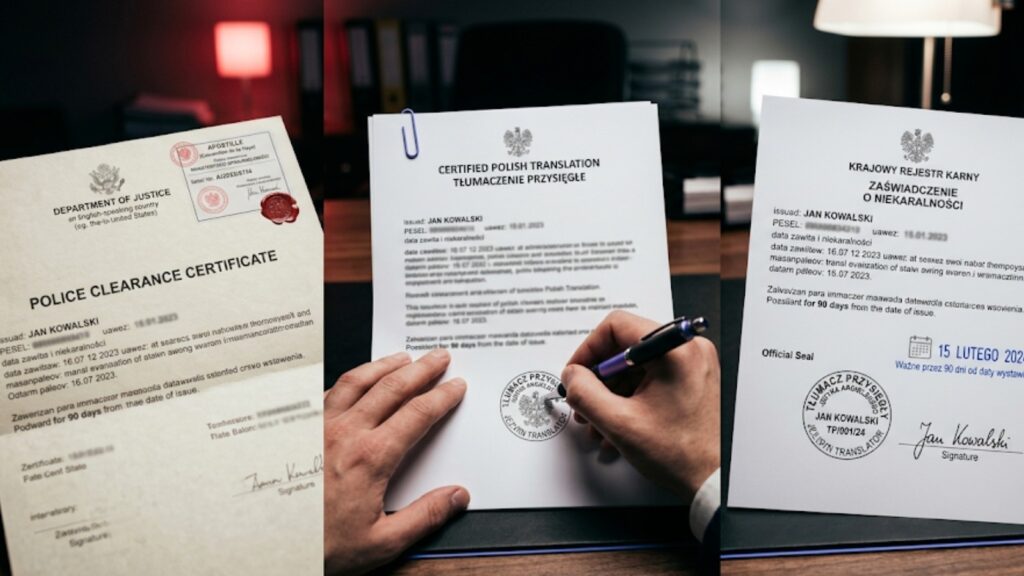
A Sworn Translator in Poland is a public official who has passed rigorous state examinations and is registered with the Ministry of Justice. Each page they translate is stamped with a unique seal and signed, certifying that the Polish version is a 100% accurate and faithful representation of the original. For a Police Clearance Certificate to be valid for official use in Poland, it must be prepared by a translator holding these specific credentials.
Who Needs This In Poland
The requirement for a criminal record check and its subsequent translation usually arises during major life transitions or legal applications. You will likely need this service if you fall into one of the following categories:
- Residence Permit Applicants: Many individuals applying for temporary or permanent residence (Karta Pobytu) are asked to provide proof of a clean criminal record from their home country or previous place of residence.
- Job Seekers in Sensitive Sectors: If you are working in education, childcare, healthcare, or the financial sector, Polish law often mandates that employers verify your criminal history.
- Professional Licenses: Foreign doctors, lawyers, or engineers seeking to practice their profession in Poland must prove their „good standing” to the relevant professional chamber.
- Citizenship Applications: When applying for Polish citizenship through the Voivode or the President, a translated PCC is a standard requirement.
- Adoption and Guardianship: Any legal proceeding involving the care of minors requires strict vetting of the applicants.

Step By Step Process
Obtaining and translating your PCC involves several specific stages. Missing one can result in your application being rejected.
- Obtain the Document: Request the certificate from the relevant authority in your home country (e.g., the FBI in the USA, the ACRO in the UK, or the local police headquarters).
- Legalization or Apostille: Before the translator can work, the document usually needs an Apostille or legalization stamp from the country of origin. This proves the document itself is authentic.
- Find a Sworn Translator: Contact a translator registered in Poland. While you can sometimes use a translator in your home country, Polish offices often reject these unless they are verified by a Polish consulate.
- Submission: Provide a clear scan or the original document to the translator.
- Collection: The final product will be a paper document with the official seal, or an electronic version signed with a qualified digital signature.
Required Documents
To complete the translation process smoothly, you should have the following ready:
- The Original PCC: Ensure it is a recent version, as these certificates often expire within 3 to 6 months according to Polish administrative standards.
- Apostille or Legalization: This should be attached to the original certificate. The translator must also translate the text of the Apostille for the document to be complete.
- Passport Copy: This helps the translator ensure that your name and place of birth are spelled exactly as they appear on your official identification.
Common Mistakes Foreigners Make
Small errors in the translation process can lead to months of delays in your residency or employment.
- Using Non-Sworn Translators: Many foreigners hire a general translation agency because it is cheaper. If the document does not have the round metal seal of a Polish Sworn Translator, the Polish government will reject it.
- Translating an Expired Document: Most Polish offices consider a PCC valid for only a short window (often 90 days). Ensure your translation is based on a fresh certificate.
- Forgetting the Apostille: A translator can translate a document without an Apostille, but the Urząd will likely reject the final package because the underlying document was not „legalized” for international use.
Conclusion
A Police Clearance Certificate is a vital document for any foreigner building a life in Poland. Because it deals with legal standing and security, the Polish authorities have zero tolerance for procedural errors. Ensuring that your PCC is translated by a certified professional not only fulfills a legal requirement but also provides peace of mind that your transition to Poland will stay on track.
If you need a fast, accurate, and legally valid translation of your Police Clearance Certificate, Sworn Translator Warsaw is here to help. Our registered sworn translators specialize in legal and administrative documentation for the expatriate community. We understand the nuances of Polish bureaucracy and ensure your documents meet every official standard.
Contact us today for a free quote and let us help you navigate your Polish legal requirements with ease.
Frequently Asked Questions
Question One: Can I use a translation done in my home country?
Usually, no. Polish administrative offices require translations to be performed by a translator registered with the Polish Ministry of Justice. If you use a foreign translator, you may need to have the translation certified by a Polish consulate, which is more expensive and time consuming.
Question Two: How long does a sworn translation take?
A standard Police Clearance Certificate is typically 1 to 2 pages long. At Sworn Translator Warsaw, the process usually takes 1 to 2 business days. Emergency or same day services are often available for urgent cases.
Question Three: Does the translator need the physical original?
While a translation can be prepared from a scan, the translator must note on the document whether they saw the original or a copy. Some offices strictly require the translation to state it was made „from the original.”
Contact us Call us+48 514 302 221 Monday – Friday
Email: Biuro@sworntranslatorwarsaw.pl
Officesul. Krucza 16/22 , Lokal- 41100-526 Warszawa