
How to Get a Polish Apostille on a Copy of a Document: The Complete Cross-Border Legalization Guide
Framework & Global Mandate
International asset protection and cross-border migration demand absolute vigilance when managing master original certificates. Specifically, high-value files like university diplomas, personal passports, corporate birth charters, and marriage deeds are difficult to replace. If you mail these unique originals across oceans, you risk permanent document loss inside global postal networks. Therefore, smart applicants seek alternative verification pathways to shield their primary archives from damage. Consequently, international legal bodies accept authenticated duplicates under the global terms of the 1961 Hague Convention.
However, you cannot simply upload a standard household xerox scan to foreign embassies or judicial departments. The reason is rooted deeply in global public record laws. Specifically, foreign case officers cannot verify the underlying source marks on an unauthenticated sheet of paper. Therefore, learning how to get a Polish Apostille on a copy of a document becomes a vital operational necessity. This specialized administrative route bridges the gap between document preservation and international legal validity. Furthermore, executing this sequence correctly keeps your immigration dossiers moving without risking your primary files.
The Core Administrative Anatomy
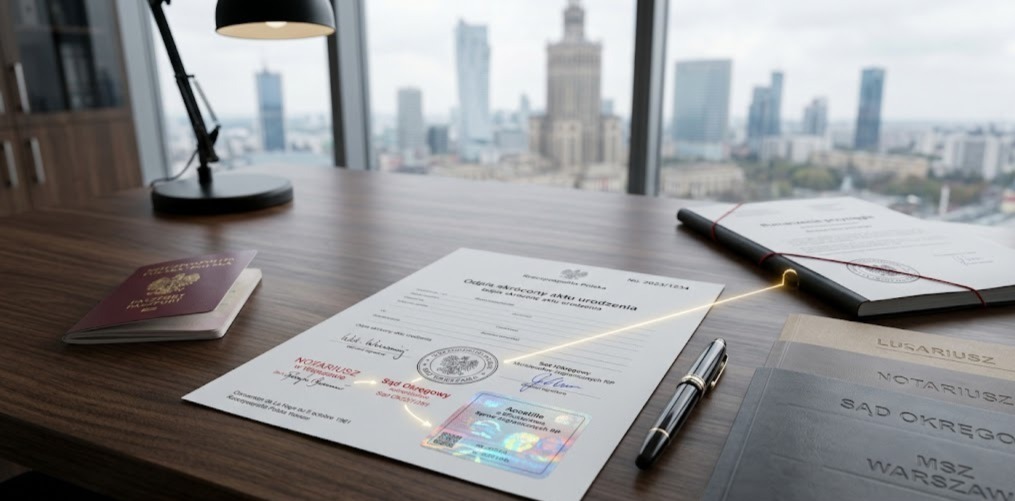
To turn a basic photocopy into a legally binding international document, it must pass through specific validation layers. First, the paper requires transformation by an authorized official inside Poland. This professional is known as a notariusz (notary public). Specifically, you must present your physical master copy directly to their office. The notary evaluates the original file for signs of alteration. Subsequently, they execute a high-resolution duplicate.
Furthermore, the notary affixes a formal legal declaration known as a klauzula poświadczeniowa (certification clause). This stamp turns the page into a kopia notarialnie poświadczona (notarial certified copy). Additionally, the notary applies their official signature, wet-ink stamps, and a unique tracking number from their repertorium ledger.
However, the validation pipeline does not stop at the notary office. Specifically, the central Ministry of Foreign Affairs (MSZ) Legalization Division in Warsaw can only verify specific classes of signatures. Consequently, a notary’s stamp often requires a middle validation step. Therefore, the certified copy must travel to the local Sąd Okręgowy (Regional Court) that directly monitors that specific notary. The court clerks apply an internal stamp confirming the notary holds an active state license. Only after this judicial step is complete will the MSZ apply the final holographic verification sticker.
Steps for Processing & Sequence Logic
Navigating this multi-tier verification process requires absolute linear precision. Therefore, any skipped step will invalidate your paperwork and stall your international applications. You or your proxy must follow this exact sequence:
1.Physical Original Presentation at the Kancelaria Notarialna:
First, bring your master document to an active Polish notary office. Specifically, the notary must physically handle the original asset to verify its security marks. Consequently, they print the official true copy featuring their state-monitored ledger serial number.
2.Judicial Authentication at the Designated Regional Court:
Second, transport the notarized copy to the relevant Sąd Okręgowy department. Specifically, the court clerks check the notary’s signature against their active database. Subsequently, they apply a signature verification stamp onto the reverse page.
3.Ministerial Submission on Krucza Street in Warsaw:.
Third, book an appointment via the e-Konsulat portal and take the folder to the MSZ legalization desk. Specifically, the official verifies the court clerk’s validation mark. Consequently, they attach the official physical Hague Apostille sticker.
4.Certified Sworn Translation Binding Process:
Finally, hand the complete multi-stamped document package over to an accredited expert. Specifically, a registered sworn translator translates the text and stamps into English. This creates a fully legal international dossier.
Verification Failure Points & Risks
Many international applicants experience severe setbacks because they attempt to use shortcuts. For instance, they believe that an electronic scan or a home printout can replace a physical notary visit. However, the Polish MSZ will immediately reject any paper that lacks real, physical wet-ink signatures from an authorized notary or judge. Consequently, your timeline will collapse if you try to submit a home-made copy.
Additionally, another common pitfall involves translation order errors. Specifically, some candidates translate their document copy before taking it to the court or the MSZ. This mistake breaks the verification chain completely. Therefore, you must remember that the Apostille sticker itself requires a full translation. If your translator cannot see the final MSZ tracking numbers, foreign immigration offices like the Canadian IRCC will flag the dossier as incomplete. As a result, you must strictly follow the legal sequence to safeguard your international visa applications.
B2B Mobility Coordination & Proxy Architecture
Corporate human resource teams and international wealth managers face significant logistics bottlenecks when handling overseas files. Specifically, coordinating signatures across different cities and ministries drains internal corporate resources. Therefore, high-earning individuals and relocation firms choose to outsource these administrative workflows to trusted local specialists.
For example, multinational advisory groups handle these complex tasks through on-the-ground proxies in Warsaw. You can manage the physical document routing, notary steps, and court submissions smoothly via Lex Corporation. In addition, you can handle the precise linguistic side through Sworn Translator Warsaw. These specialized local providers act as your authorized legal proxy. Consequently, they execute the entire physical walk-in sequence without requiring you to mail your unique original deeds outside your home country.
Frequently Asked Questions
Can I get a Polish Apostille on a copy of a document without a notary stamp?
No. Specifically, the Ministry of Foreign Affairs cannot directly verify standard photocopies. Therefore, you must obtain a kopia notarialnie poświadczona from a notary to create an official public record first.
What unique ledger data must the notary copy display for MSZ clearance?
The copy must show the notary’s signature and the unique Repertorium A ledger number. You can verify the strict statutory guidelines for these seals directly on the official Ministry of Justice Portal.
Can a local proxy manage the court and MSZ steps on my behalf?
Yes. Consequently, you do not need to fly to Warsaw. An authorized local representative can complete the physical court submissions using a standard authorization letter.
Why do foreign consulates reject simple scanned copies of Polish records?
Scanned printouts lack physical security marks and official holographic stickers. Therefore, foreign case officers classify them as unauthenticated papers. As a result, you must supply a physically apostilled copy.
Where can I check if my target country accepts apostilled document copies?
You can verify the current treaty membership status across all nations via the official Hague Conference Status Table. If your target nation is an active member, they accept this format.
Contact Sworn Translator Warsaw Today
Ultimately, are you ready to start your Polish Apostille remotely? Undoubtedly, we are here to help. Specifically, our expert team guarantees a fast and totally stress-free process. Furthermore, we process documents for clients all over the world.
Therefore, do not waste your time traveling to Warsaw. Instead, let our specialists handle the bureaucracy.
Get in touch with us right now: Sworn Translator Warsaw