AI Translation vs. Human Translation: When Should a Business Use Each?
Introduction
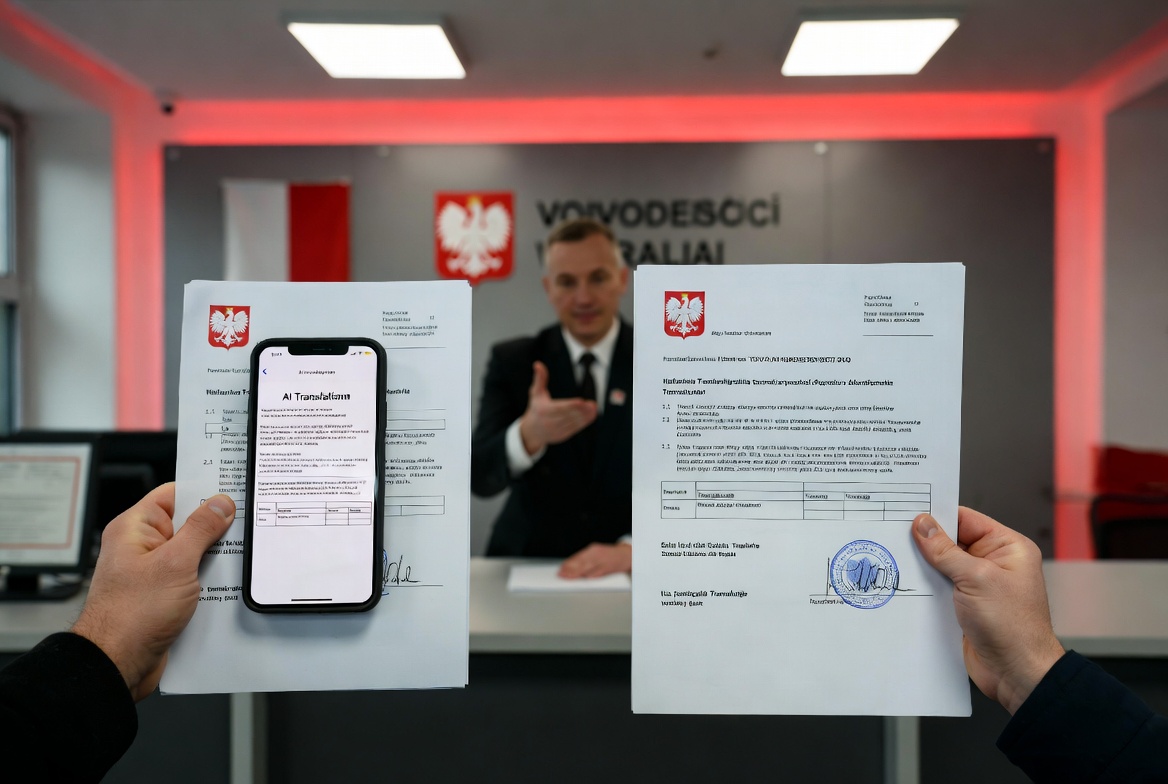
You open a translation app, paste your employment contract into it, and within seconds you have a result in Polish. It looks clean. It reads well. Then you submit it to the Urząd Wojewódzki and the officer hands it back. Not accepted. It is not a sworn translation.
. For foreign workers, students, and families relocating to Poland, the difference between AI translation and sworn human translation is not a matter of preference. It is a legal requirement that directly affects whether your visa is processed, your documents are accepted, or your case can move forward.
At the same time, AI tools are genuinely useful in the right situations. The real challenge is knowing when each type is appropriate and when using the wrong one costs you weeks of lost time.
What This Means: AI Translation and Sworn Human Translation Explained
AI Translation
AI translation tools such as Google Translate, DeepL, and Microsoft Translator convert text between languages using machine learning. They are fast, widely available, and largely free.
For informal use they work well. But for legal, medical, or official documents they have serious limitations. They miss context that changes legal meaning. They struggle with Polish administrative and legal terminology. And critically, no AI tool can certify accuracy or take legal responsibility for its output.
Human Sworn Translation
A sworn translator (tłumacz przysięgły) is a professional who has passed a state examination set by the Polish Ministry of Justice and taken an official oath. Their name appears on the Ministry’s public register.
Every sworn translation is stamped, signed, and entered into the translator’s official numbered repertory. That stamp and signature is what makes a document legally valid for Polish courts, government offices, and public institutions. A sworn translator takes personal and professional responsibility for every translation they produce. AI tools cannot do this.
Who Needs Sworn Human Translation in Poland
- Foreign workers need sworn translations of diplomas, criminal background checks, employment contracts submitted to authorities, and non EU identity documents.
- International students need sworn translations of school diplomas, transcripts, and sometimes birth certificates for university registration.
- Expatriates relocating to Poland need them for registering foreign marriages, births, and divorces with civil registry offices, converting foreign driver’s licenses, and applying for permanent residence or citizenship.
- Businesses registering in Poland or involved in Polish legal proceedings need sworn translations of incorporation documents, board resolutions, and financial statements submitted to public bodies.
When AI Translation Is Appropriate
It is important to be fair about this. AI translation tools have a legitimate and useful place in a business context. Understanding when to use them prevents unnecessary expense and saves time.
AI translation works well for:
- Internal communication. When your team needs to understand a document from a foreign partner for internal discussion purposes, not for submission to any official body, an AI translation gives quick access to the content.
- Initial research. When you are reviewing a large volume of foreign language material to decide which documents are relevant, AI tools let you scan efficiently before investing in professional translation.
- Informal correspondence. Emails, chat messages, internal notes, and informal updates between international colleagues do not require sworn or certified translations. AI tools handle these well.
- Website localization review. When translating marketing content or product descriptions for a foreign market, AI tools can produce a draft that a bilingual editor then reviews and refines. This is faster and more cost effective than starting from scratch with a human translator, provided the final version is reviewed by a professional.
- Understanding what a document says. If you receive a document in Polish and need to understand its general meaning before discussing it with your lawyer or adviser, AI translation gives you that overview quickly.
The critical rule is this: if the translated document will be submitted to any official authority, court, government body, bank, notary, or institution in Poland, AI translation is not sufficient. You need a sworn translation.

When Only a Sworn Human Translator Will Do
The Act on the Profession of Sworn Translator (Ustawa z dnia 25 listopada 2004 r. o zawodzie tłumacza przysięgłego) establishes that documents submitted to public institutions in Poland must be translated by a person on the official Ministry of Justice register.
This includes without exception:
- Visa and residence permit applications at the Voivodeship Office (Urząd Wojewódzki) and all supporting documents.
- Court proceedings where foreign language documents are submitted as evidence.
- Notarial acts involving parties who do not speak Polish, or documents from abroad referenced in a notarial deed.
- Registration of foreign civil status documents such as marriage, birth, or death certificates at Polish civil registry offices (USC).
- Academic credential recognition for regulated professions such as medicine, law, and architecture.
- Real estate transactions involving parties with foreign identity documents.
Step by Step: How the Process Works
- Step 1. Identify which documents need sworn translation and confirm with the receiving institution exactly what they require.
- Step 2. Verify the translator is on the official Ministry of Justice register at rejestry.ms.gov.pl. Working with an unregistered person produces a document with no legal validity.
- Step 3. Provide the original document. A sworn translation made from an unauthenticated photocopy may not be accepted by some institutions.
- Step 4. The translator prepares the translation, adds a statement of accuracy, and stamps and signs it with their official seal.
- Step 5. The translation is entered into the translator’s official repertory and assigned a unique number, which appears on the document.
- Step 6. You receive the completed translation. Confirm with the receiving office whether they require the physical stamped original or whether a scan is acceptable.
Documents That Commonly Require Sworn Translation
- Personal: birth, marriage, divorce, death certificates, adoption records.
- Identity: national identity cards from non EU countries, military service records.
- Educational: university diplomas, transcripts, school leaving certificates, professional qualification certificates.
- Legal: court judgments, criminal record certificates, power of attorney documents from abroad.
- Employment and professional: employment contracts for public bodies, professional licenses, references for regulated professions.
- Business: incorporation certificates, shareholder agreements, financial statements for Polish courts or authorities.
- Medical: medical reports, disability certificates, vaccination records for residency or employment.
Common Mistakes Foreigners Make
- Submitting an AI translation. Government offices do not evaluate translation quality. They look for the sworn translator’s stamp. If it is missing, the document is rejected without further review.
- Using a bilingual friend. Unless they are a registered sworn translator, their translation has no legal standing regardless of accuracy.
- Confusing certified and sworn translation. A certified translation from another country is not the same as a Polish sworn translation. They are different legal categories.
- Using a photocopy. Always provide originals where possible. Some offices will not accept sworn translations made from unauthenticated copies.
- Leaving it too late. Standard turnaround is several business days. Plan ahead, especially if you have a fixed appointment at a government office.
- Assuming one translation covers multiple submissions. Each stamped copy is a separate document. Multiple institutions may each require their own copy.
Conclusion
AI translation tools are useful, fast, and cost effective for internal and informal purposes. But when a document needs to stand before a Polish government office, court, or notary, only a sworn translation produced by a registered tłumacz przysięgły will be accepted. No AI tool meets that legal standard.
Understanding this distinction early saves significant time, stress, and money. For anyone navigating official procedures in Poland as a foreigner, using the right type of translation from the start is one of the simplest and most important steps you can take.
Frequently Asked Questions
Can I use DeepL or Google Translate for my Polish visa application?
No. The Voivodeship Office requires sworn translations of all supporting documents. AI translations will not be accepted and your application may be returned or rejected.
How do I verify a sworn translator is officially registered?
Check the Ministry of Justice public register at rejestry.ms.gov.pl. You can search by name, language, or city. Anyone not on that register cannot produce a legally valid sworn translation in Poland.
How long does a sworn translation take and what does it cost?
A standard personal document typically takes two to five business days. Fees are generally charged per page of the original. Urgent processing is available from some translators at an additional cost. Contact the translator directly to discuss your timeline and requirements.
Contact us Call us+48 514 302 221 Monday – Friday
Email: Biuro@sworntranslatorwarsaw.pl
Officesul. Krucza 16/22 , Lokal- 41100-526 Warszawa