
The Hidden Risks of Using Non Certified Translations in Poland for Official Documents
Introduction
For many foreigners in Poland, dealing with official procedures can quickly become confusing. Whether you are applying for a residence permit, enrolling at a university, or starting a job, documents play a central role in every step.
One of the most underestimated challenges is translation. Many people assume that any translation is acceptable as long as the content is accurate. In reality, Polish authorities often require a specific type of translation that has legal validity.
Using a non certified translation might seem faster or cheaper at first, but it can lead to serious consequences such as application rejection, delays, or even legal complications. Understanding these risks early can save time, money, and stress.
What This Means
In Poland, a certified translation is not just a language conversion. It is a legally recognized document prepared and signed by a sworn translator registered by the Ministry of Justice.
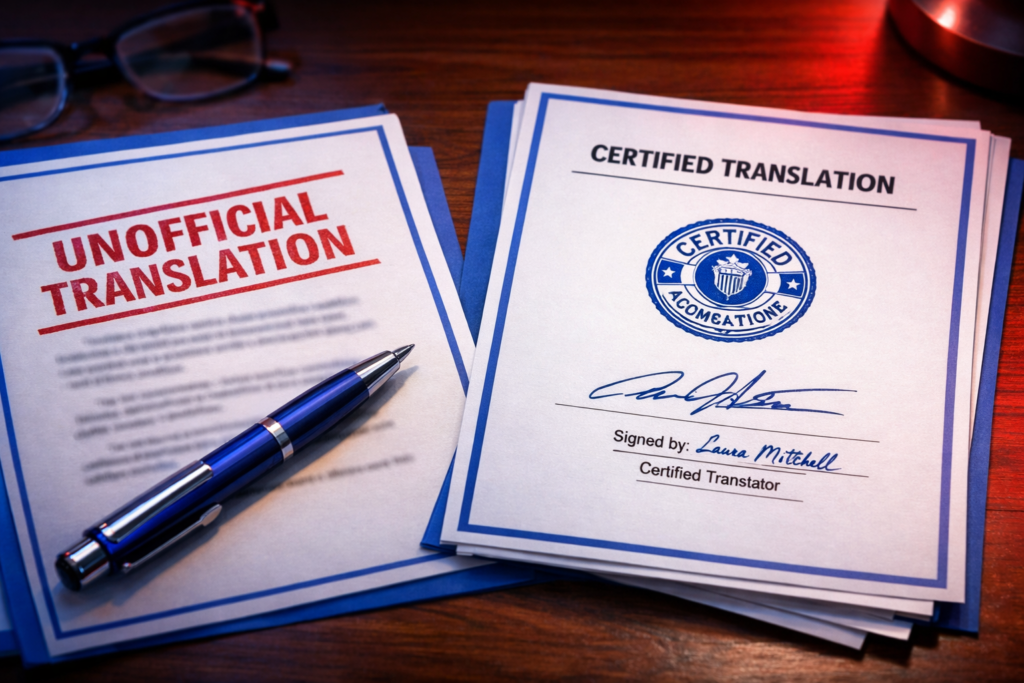
A non certified translation, even if linguistically correct, does not carry legal authority. This means that government offices, courts, universities, and many employers may refuse to accept it.
The key difference is legal accountability. A sworn translator confirms that the translation is accurate and complete, and their signature and official stamp make the document valid for formal use.
Without this certification, the translation is treated as informal and cannot be relied upon in official procedures.
Who Needs This In Poland
Certified translation is required in many real situations involving foreigners. These include:
Residence and Immigration
- Applications for temporary or permanent residence permits
- Visa related documentation
- Civil status documents such as birth or marriage certificates
Education
- University admissions
- Recognition of foreign diplomas
- Academic transcripts and certificates
Employment
- Work permits
- Employment contracts
- Professional qualification
Legal and Administrative Matters
- Court documents
- Power of attorney
- Business registration documents
If a document is issued in a foreign language and is submitted to a Polish authority, there is a strong chance that a sworn translation will be required.

Step By Step Process
Understanding how the process works helps avoid unnecessary delays.
Step One Document Review
You provide the original document or a clear scan. The translator checks the content, format, and purpose of use.
Step Two Confirmation of Requirements
The translator confirms whether a sworn translation is required based on the authority or institution involved.
Step Three Translation
The document is translated with attention to both language accuracy and legal terminology.
Step Four Certification
The sworn translator signs and stamps the translation, confirming its accuracy and completeness.
Step Five Submission
You submit the certified translation along with the original document to the relevant authority.
In some cases, authorities may request both the original and the translation to be presented together.
Required Documents
While requirements vary depending on the procedure, the most commonly translated documents include:
- Birth certificates
- Marriage certificates
- Diplomas and academic transcripts
- Employment certificates
- Court decisions
- Police clearance certificates
- Medical records
- Business registration documents
Each document must be translated fully, including stamps, signatures, and official notes. Partial translation is usually not accepted.
Common Mistakes Foreigners Make
Assuming Any Translation Is Acceptable
Many people rely on regular translators or even self translation. Authorities often reject these documents immediately
Not Checking Requirements in Advance
Different offices may have different rules. Submitting the wrong type of translation leads to delays.
Choosing Based on Price Alone
Lower cost translations may not meet legal standards, resulting in additional costs later when the document needs to be redone.
Submitting Incomplete Documents
Missing pages, unclear scans, or untranslated sections can invalidate the entire submission.
Waiting Until the Last Minute
Certified translation takes time, especially for complex documents. Delays can affect deadlines for applications or legal processes.
Conclusion
Using a non certified translation in Poland carries more risk than many foreigners expect. Even a small misunderstanding about requirements can lead to rejected applications, missed deadlines, and added stress.
Certified translation ensures that your documents are legally valid and accepted by Polish authorities. It is not just about language accuracy, but about meeting formal legal standards.
Understanding this distinction is essential for anyone navigating administrative procedures in Poland.
If you need legally valid translations for official use in Poland, working with an experienced sworn translator is the safest approach.
Sworn Translator Warsaw provides certified document translation and official interpretation tailored to the requirements of Polish institutions. Whether you are applying for residence, studying, working, or handling legal matters, professional support can help you avoid costly mistakes and delays.

Frequently Asked Questions
Question One
Do all documents need certified translation in Poland?
Not all, but any document submitted to a government office, court, or university often requires a sworn translation. It depends on the institution.
Question Two
Can I translate my own documents?
No. Self translation is not accepted for official purposes. A sworn translator must certify the translation.
Question Three
What happens if I submit a non certified translation?
The document may be rejected, and your application can be delayed or denied until a proper certified translation is provided.
Contact us Call us+48 514 302 221 Monday – Friday
EmailBiuro@sworntranslatorwarsaw.pl
Officesul. Krucza 16/22 , Lokal- 41100-526 Warszawa