
Apostille vs Sworn Translation in Poland: What Most Foreigners Get Wrong
Introduction: Two Terms, One Very Common Confusion
If you are a foreigner living in Poland, working here, studying here, or going through any kind of official administrative process, you have probably come across two terms that cause enormous confusion: apostille and sworn translation.
Many people assume they are the same thing. Others think one replaces the other. Some believe that getting an apostille on a foreign document means it is automatically valid in Poland without any additional steps. In practice, none of these assumptions are correct, and acting on them can lead to rejected applications, wasted money, delayed visas, and serious problems with Polish authorities.
This article explains clearly what each term means, how they differ from each other, when you need one or both, and what the process looks like in Poland. There is no legal jargon here. The goal is simply to help you understand what you are dealing with and avoid the mistakes that slow so many foreigners down.
What Is an Apostille?
An apostille is a certificate that confirms the authenticity of a public document. It does not translate anything. It does not verify the content of a document. What it does is verify that the signature, seal, or stamp on a document is genuine and that the authority who issued the document had the legal authority to do so.
The apostille system was created under the Hague Convention of October 5, 1961, formally called the Convention Abolishing the Requirement of Legalisation for Foreign Public Documents. Countries that signed and ratified this convention agree to recognize each other’s public documents when they carry a specific apostille certificate attached to them.
Poland ratified the Hague Apostille Convention and has been a member state since 1962. (Source: Hague Conference on Private International Law, status table for Convention No. 12 — https://www.hcch.net/en/instruments/conventions/status-table/?cid=41)
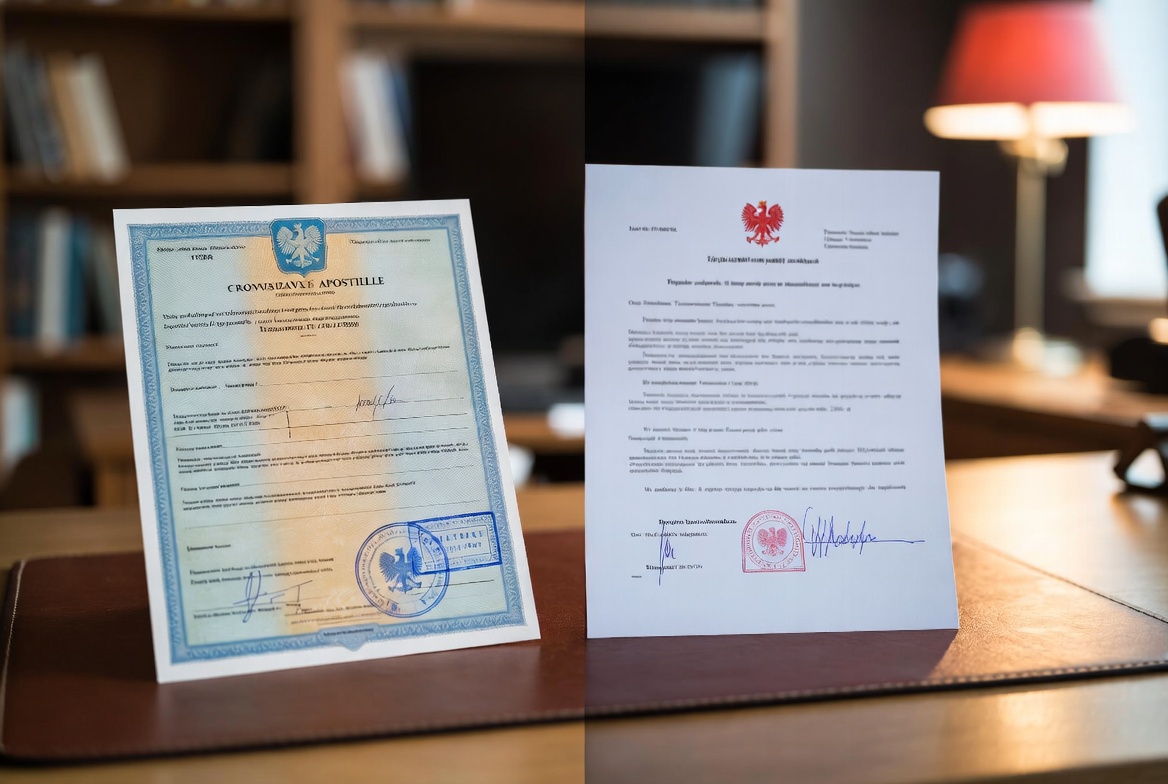
What an apostille looks like
An apostille is typically a stamp or certificate placed directly on the original document or attached to it on a separate page. It contains standardized information including the country of origin, the name of the authority that signed the document, the date, and a reference number. The format is standardized across all member countries.
Who issues an apostille
Apostilles are issued by a designated authority in the country where the document was originally produced. This is not a translator. It is not a notary in every case. The issuing authority depends on the type of document and the country.
For example, if you have a birth certificate issued in Germany and you need an apostille on it, you would request that apostille from the relevant German authority before bringing the document to Poland. Poland does not issue apostilles on foreign documents.
Within Poland, apostilles on Polish public documents are issued by:
- Regional courts (sądy okręgowe) for court documents and notarial acts
- The Ministry of Foreign Affairs for documents issued by central state authorities
- Provincial governors (Wojewodowie) for regional administrative documents
(Source: Polish Ministry of Foreign Affairs guidance on apostille — https://www.gov.pl/web/dyplomacja/apostille)
What an apostille does NOT do
This is the most important point in this entire article. An apostille does not translate your document. A document written in German, French, or Ukrainian does not become readable or legally usable in Polish administrative proceedings just because it carries an apostille stamp. Polish authorities work in Polish. If your document is not in Polish and does not have a certified Polish translation, it will not be accepted regardless of how many apostille stamps are on it.
What Is a Sworn Translation in Poland?
A sworn translation (in Polish: tłumaczenie przysięgłe) is a translation of a document that has been completed and certified by a sworn translator officially registered with the Polish Ministry of Justice.
A sworn translator in Poland is not just a bilingual professional. They are a licensed practitioner who has passed a state examination, taken an official oath before the Ministry of Justice, and been entered into the official register of sworn translators. They bear personal legal responsibility for the accuracy and completeness of every translation they certify.
Every sworn translation in Poland is:
- Completed in writing by a licensed sworn translator
- Stamped with the official round seal of the sworn translator
- Signed by the sworn translator personally
- Numbered and entered into the sworn translator’s official log book (repertorium)
- Accompanied by a statement confirming that the translation is accurate and complete
(Source: Act on the Profession of Sworn Translator, November 25, 2004, Journal of Laws 2004, No. 273, Item 2702 — Ustawa z dnia 25 listopada 2004 r. o zawodzie tłumacza przysięgłego)
What a sworn translation produces
The result is a document in Polish (or in the target language, depending on the direction of translation) that Polish courts, the police, the voivodeship office, the university admissions office, the National Labour Inspectorate, and all other official bodies in Poland are legally required to accept as equivalent to the original document for official purposes.
Who can perform sworn translations in Poland
Only sworn translators registered in the official list maintained by the Polish Ministry of Justice. You can verify any sworn translator’s credentials using the Ministry’s public online registry.
(Source: Ministry of Justice Register of Sworn Translators — https://www.ms.gov.pl/pl/rejestry-i-ewidencje/tlumacze-przysiegli/lista-tlumaczy-przysieglych/)
Translations performed by ordinary professional translators, certified translators without sworn status, bilingual friends, or agency translations without a sworn stamp are not legally valid for official procedures in Poland.
Key Differences: Apostille and Sworn Translation Are Not the Same Thing
Here is a plain comparison of what each one does:
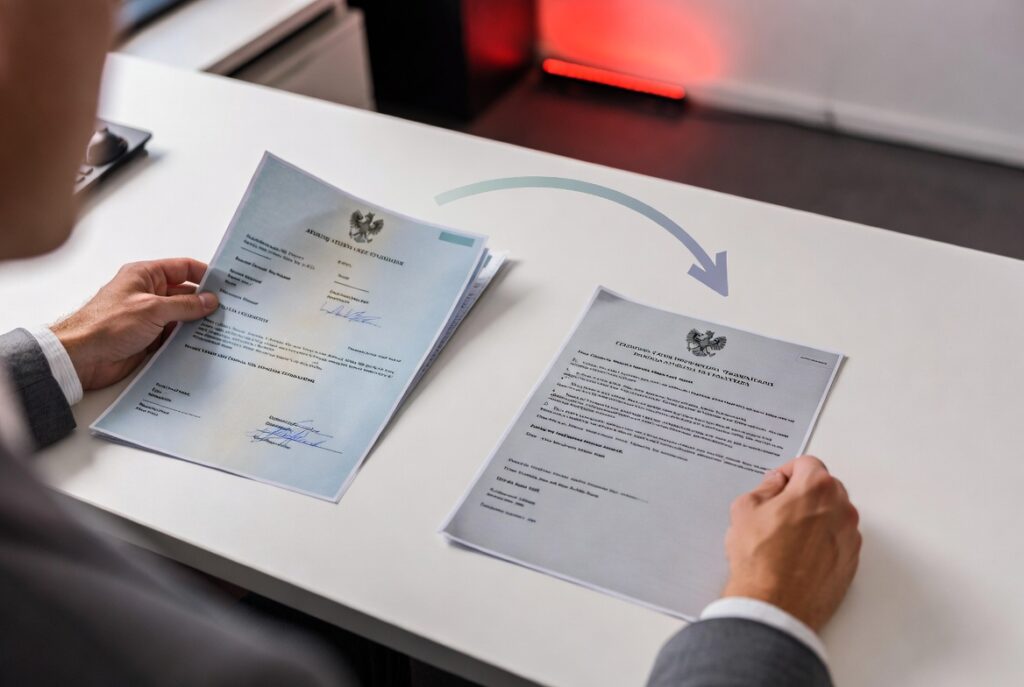
Apostille: Confirms that a document issued in one country is genuine and was signed or issued by a real, authorized authority in that country. It is a form of international authentication. It says: this document is real and was issued by a recognized authority.
Sworn Translation: Produces a legally certified Polish language version of a foreign document. It says: this is an accurate and complete translation of the original document, certified by a licensed professional who is legally accountable for it.
One authenticates origin. The other produces a certified language version. They are two entirely separate steps serving two entirely different purposes.
A simple way to think about it:
Imagine you have a birth certificate from Ukraine. The apostille on that certificate tells Polish authorities that the Ukrainian document was genuinely issued by a Ukrainian civil registry and that the official who signed it had the authority to do so. The sworn translation tells Polish authorities what that document actually says, in Polish, in a legally certifiable form.
Without the apostille (if required), there is uncertainty about whether the document is genuine.
Without the sworn translation, Polish authorities cannot read or process it regardless of its authenticity.
In many situations, you need both. In some situations, you need only the sworn translation. In rare situations, the apostille alone is enough — but this is almost never the case for documents submitted to Polish administrative or court proceedings.
Who Needs What in Poland
Foreign Workers and Employees
If you are a foreigner working in Poland or applying for a work permit, you will almost certainly need sworn translations of documents such as:
- Your foreign diploma or qualification certificate (required for regulated professions and many employer processes)
- Your employment history or work certificates from abroad
- Criminal record clearance documents from your home country
- Your foreign identity documents or civil registry documents
The voivodeship office (Urząd Wojewódzki), which handles residence and work permit applications, requires sworn translations of foreign language documents. Many employers in regulated industries also require sworn translations of foreign qualifications.
If your diploma or qualification certificate comes from a non EU country, it may also need to carry an apostille before the sworn translation is obtained.
International Students
International students enrolling in Polish universities commonly need sworn translations of:
- Secondary school leaving certificates (high school diplomas, A levels, baccalaureate certificates)
- Academic transcripts
- Birth certificates
- Previous university degrees (for graduate admissions)
Polish universities and their admissions offices accept only sworn translations for foreign language documents. An ordinary certified translation or a notarized translation is not sufficient.
Expats and People Relocating to Poland
If you are relocating to Poland permanently or for a longer period, the documents that most commonly require sworn translation include:
- Birth certificates (needed for registering a birth in Poland, applying for a PESEL number, and many other procedures)
- Marriage certificates (needed for updating civil status records in Poland, applying for family reunification, opening joint bank accounts with legal formality)
- Divorce decrees
- Adoption papers
- Criminal background checks
If these documents come from countries outside the EU, they will often need both an apostille and a sworn translation.
People Going Through Legal Proceedings
If you are involved in a court case in Poland, whether civil, criminal, or administrative, any document you submit in a foreign language must be accompanied by a sworn translation. Polish courts do not accept foreign language documents without certification.
This includes evidence submitted to courts, power of attorney documents from abroad, inheritance documents, property deeds, and contracts.
Step by Step Process
How to Get an Apostille
Step 1: Identify where your document was issued. The apostille must be obtained from the country of origin of the document, not from Poland.
Step 2: Contact the designated competent authority in that country. Each Hague Convention member country has designated specific authorities to issue apostilles. The Hague Conference website lists competent authorities for all member countries. (Source: https://www.hcch.net/en/instruments/conventions/specialised-sections/apostille/authorities)
Step 3: Submit the original document to the competent authority. In most countries this is done by post or in person. Some countries offer online services.
Step 4: Receive the apostille. It will be attached to or stamped onto your document.
Step 5: Bring the apostilled document to Poland for the next steps, including sworn translation if required.
Note: If your document comes from a country that has not signed the Hague Convention, a more complex process called full legalization or consular legalization is required. This involves authentication by the Ministry of Foreign Affairs of the country of origin and then by the Polish consulate or embassy in that country. You should consult a qualified professional if this applies to your situation.
How to Get a Sworn Translation in Poland
Step 1: Identify a licensed sworn translator. Use the official Ministry of Justice registry to verify that the translator holds a valid license for your language pair. (Registry: https://www.ms.gov.pl/pl/rejestry-i-ewidencje/tlumacze-przysiegli/lista-tlumaczy-przysieglych/)
Step 2: Provide the original document or a high quality copy. Most sworn translators in Poland can work from a clear scan or photocopy, though for some purposes the original may be required. Confirm this with the translator before proceeding.
Step 3: Receive the sworn translation. The completed sworn translation will include the full text translated into Polish (or the target language), the translator’s official seal, their signature, and a statement of accuracy. It will also have a number corresponding to the entry in the translator’s log book.
Step 4: Submit both the original (or apostilled) document and the sworn translation to the relevant Polish authority.
Important: Do not lose the sworn translation. It is a legal document. If you need additional copies, the sworn translator can produce certified copies with a statement that the copy matches the original translation.
Documents That Commonly Require Sworn Translation in Poland
Civil status documents: Birth certificates, marriage certificates, divorce certificates, death certificates, adoption papers
Educational documents: School leaving certificates, academic diplomas, university degrees, transcripts of records, certificates of professional qualification
Legal and judicial documents: Criminal record certificates, court judgments, powers of attorney, wills and testaments, adoption decrees
Employment and professional documents: Work experience certificates, employment contracts (when submitted to authorities), professional licenses, certificates of no criminal record for professional purposes
Identity and travel documents: Passports (specific pages as required), national identity cards (where translations are required for specific proceedings), driver’s licenses (in certain legal contexts)
Corporate and business documents: Commercial registration certificates, articles of association, shareholder agreements submitted to Polish courts or authorities
Medical documents: Medical reports, disability certificates, vaccination records submitted to Polish schools or employers
Common Mistakes Foreigners Make
Assuming a regular translation is the same as a sworn translation
This is the most frequent error. A person pays a translation agency, receives a professional quality translation, submits it to the voivodeship office or a Polish court, and has it rejected immediately. The reason is that only sworn translators can produce legally valid translations in Poland. Agency translations, even if accurate, do not carry legal validity unless they were completed by a registered sworn translator who stamped and signed them in the proper format.
Getting a sworn translation before getting the apostille
If your document needs an apostille, you should obtain the apostille first and then have the complete apostilled document sworn translated. Some authorities in Poland want the sworn translation to cover the entire document including the apostille text. If you get the sworn translation first and then add the apostille, you may need to have the translation redone or supplemented.
Assuming that EU documents do not need apostilles
Within the European Union, Regulation (EU) 2016/1191 simplifies the circulation of certain public documents between EU member states. This regulation means that certain civil status documents issued in one EU country and used in another EU country are exempt from the apostille requirement. However, this does not eliminate the need for sworn translation. The document still needs to be in Polish for Polish authorities to process it, and a sworn translation is still required. (Source: Regulation (EU) 2016/1191 — https://eur-lex.europa.eu/legal-content/EN/TXT/?uri=CELEX%3A32016R1191)
Submitting photocopies without proper certification
Some Polish authorities require that the sworn translation be based on or accompanied by a certified copy of the original document. In certain cases, a notarized copy of the original is needed before the sworn translation. Check with the specific authority you are submitting to about their exact requirements.
Using a sworn translator not registered for the correct language
Sworn translators in Poland are registered for specific language pairs. A sworn translator registered for English to Polish cannot legally certify a translation from Ukrainian to Polish. Always verify that the translator holds the correct language pair license using the Ministry of Justice registry.
Waiting until the last moment
Obtaining an apostille from a foreign authority can take days or weeks depending on the country. Sworn translation in Poland is typically faster, but complex or lengthy documents take time too. Many visa, residence permit, and employment permit deadlines are strict. Building in enough time to complete both steps properly is essential.
Trusting unofficial online services without verification
There are numerous websites and freelance services online that offer „certified translations” or „official translations” at low prices. Unless the translator is listed in the Polish Ministry of Justice sworn translator registry, their work will not be accepted by Polish authorities. Always verify credentials before paying for any translation service.
Conclusion: Two Different Tools for Two Different Problems
Apostille and sworn translation are not competing options. They are not interchangeable. They solve two different problems in the process of making a foreign document officially valid in Poland.
The apostille tells Polish authorities that your document is genuine and was issued by a real authorized body in its country of origin.
The sworn translation tells Polish authorities what that document says, in Polish, in a legally certified and accountable form.
Understanding this distinction saves you time, money, and frustration. It means you arrive at the voivodeship office, the court, the university admissions department, or any other Polish institution with the right documents in the right form. It means your application does not come back with a rejection stamp.
Poland’s bureaucratic system can feel overwhelming for newcomers. The language barrier alone is a serious challenge. Adding document authentication requirements on top of that makes the process harder still. But once you understand what each step actually does, the process becomes much more manageable.
If you are not sure whether your specific document needs an apostille, a sworn translation, or both, the safest course of action is to consult with a licensed sworn translator who knows Polish document requirements well. A few minutes of professional guidance at the start can prevent weeks of delays later.
Frequently Asked Questions
Do I need both an apostille and a sworn translation?
In many cases, yes. If you have a document issued in a country outside the European Union (or in an EU country where Regulation 2016/1191 does not apply to that document type), you typically need the apostille first to verify the document’s authenticity, and then a sworn translation so Polish authorities can read and process it. However, the exact requirements depend on the type of document and the specific Polish authority you are submitting to. When in doubt, contact the relevant Polish office or a licensed sworn translator to confirm what is required in your situation.
Can any translator provide a sworn translation in Poland?
No. Only translators who are officially registered as sworn translators by the Polish Ministry of Justice can provide legally valid sworn translations in Poland. These translators have passed a state examination, taken an official oath, and hold a license for specific language pairs. You can verify any translator’s credentials on the Ministry of Justice public registry. A translation produced by an unregistered translator, even a highly qualified professional, does not have legal validity for official purposes in Poland.
How long does a sworn translation take in Poland?
For standard documents such as birth certificates, marriage certificates, diplomas, or short official letters, most sworn translators in Poland deliver within one to three working days. For urgent requests, many sworn translators offer express turnaround, sometimes within the same day or next day, often for an additional fee. Longer documents such as full court files, detailed contracts, or lengthy medical records take more time. It is always worth contacting the translator in advance to confirm timelines, especially if you are working toward a deadline.
Is an apostille enough for Polish authorities to accept my document?
Not on its own, if the document is in a foreign language. An apostille confirms authenticity and origin. It does not translate the document into Polish. Polish administrative offices, courts, universities, and most official bodies in Poland require documents to be in Polish or accompanied by a sworn translation into Polish. Even if your document carries a valid apostille, it also needs a sworn translation for Polish authorities to process it.
Contact us Call us+48 514 302 221 Monday – Friday
Email: Biuro@sworntranslatorwarsaw.pl
Officesul. Krucza 16/22 , Lokal- 41100-526 Warszawa