
What Happens If Your Translation Has Errors in Poland?
Introduction
You spent weeks gathering documents. You found someone to translate them. You went to the voivodeship office, waited in the queue, and submitted your application. Then, weeks or months later, a letter arrives telling you the decision is negative. Buried inside the official Polish text is the cause: something in your translation was wrong.
This happens to foreign workers, students, expatriates, and families across Poland every year. A name rendered incorrectly, a date formatted differently than the original, a stamp not mentioned in the translation. Each of these can be enough to cause a rejection, a formal request for corrections, or a suspension of your entire application.
What makes this situation especially painful is that you may have done everything else correctly. You submitted your documents, trusted someone to translate them, and now your legal status in Poland is at risk because of errors you could not even read.
This article explains what happens when a translation contains errors in Poland, what the legal consequences are, what your rights and options are, and how to make sure it does not happen to you in the first place.
What This Means: How Translation Errors Affect Official Procedures
The Legal Weight of a Sworn Translation
A sworn translation in Poland is not just a translation. It is a legal document. It carries the weight of an official certification by a state-registered professional. Polish courts, government offices, the civil registry, immigration authorities, and notaries all rely on sworn translations as the standard for foreign-language documents.
When you submit a sworn translation to a Polish authority, that office treats it as the official Polish version of your document. If that version contains errors, the consequences flow directly from those errors.
What Counts as an Error
Not all errors are the same, but in Poland’s administrative system, even small ones matter because offices compare documents very carefully for internal consistency. Common problems include a name spelled differently than in other submitted documents, a date formatted incorrectly, the issuing authority named wrongly or omitted, stamps or seals on the original document that are not described in the translation, and a professional title translated when it should have been left in the original language.
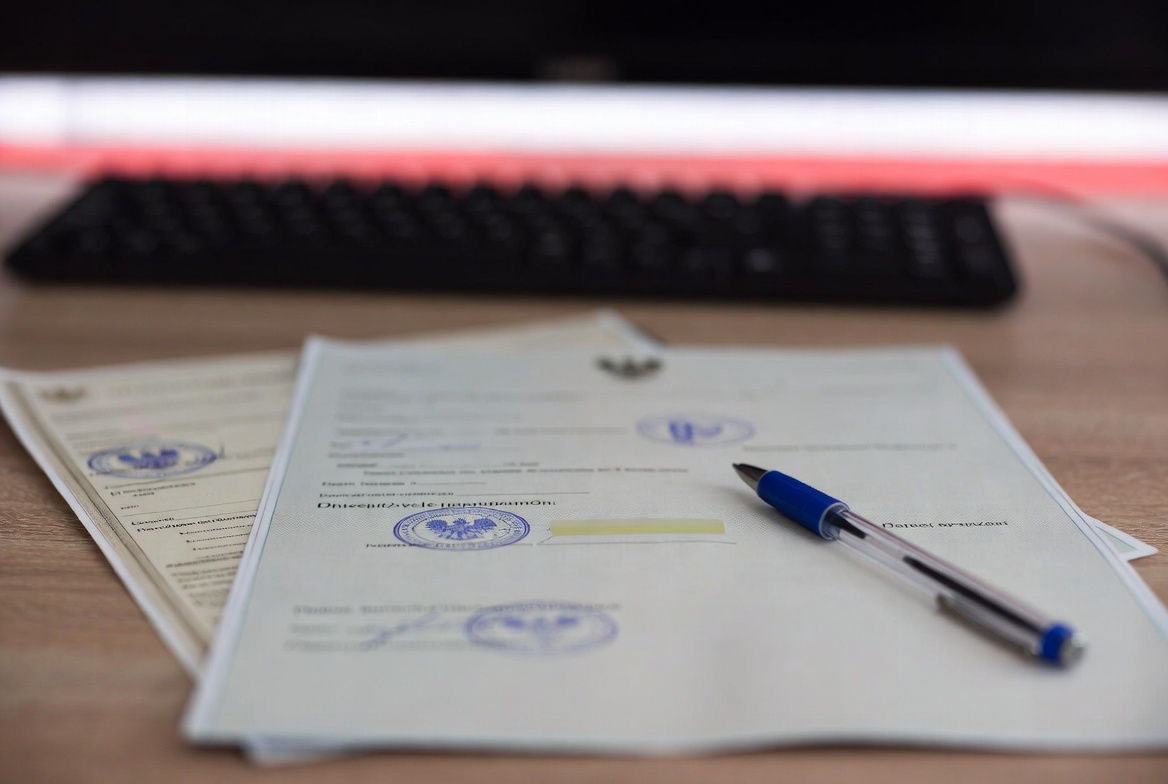
A certified translation is much more than a linguistic conversion. It must include specific formal elements required by the Ministry of Justice, such as the description of every seal, watermark, signature, and marginal note. Most informal translations lack these mandatory formal descriptions.
This catches many people off guard. If your document has a stamp in the corner, a handwritten annotation at the bottom, or a security feature described in small print, a proper sworn translation must describe all of these. A translation that ignores them is formally incomplete.
Why Errors Are Traceable
Sworn translators take responsibility for their translations and are subject to professional liability. The translations they provide are traceable since they are recorded at individual item numbers in the register called the Repertorium. Every sworn translation submitted to a Polish office can be traced back to the specific translator who produced it, and that translator bears legal responsibility for its accuracy.
Who Is Affected
Residence Permit Applications
This is the most common situation. Missing documents, expired documents, or documents not accompanied by sworn Polish translations are a leading cause of delays and refusals. Failure to provide the required documentation may result in a negative decision. If a translation of your birth certificate spells your name differently than your passport, or if your marriage certificate translation renders the issuing registry incorrectly, the office may suspend processing or issue a rejection.
Work Permit Applications
Any document that is not in Polish must be translated by a Polish sworn translator. If you skip this, or use a translator from another country, the office will reject the document and you will be told to resubmit, causing serious delays.
Educational Documents and Notification
The automated system used for diploma recognition in Poland is unforgiving. A missing translation stamp or the wrong file format can lead to immediate rejection. If the system finds a mistake, you have 14 days to correct it. Missing this deadline means your application will be rejected.
Court and Legal Proceedings
While regular translators have civil liability for errors, sworn translators are bound by stricter professional rules and are criminally liable for breaking them. Their work ensures translations meet the highest standards of accuracy, crucial in situations where errors could lead to significant legal or financial consequences.

What Happens Step by Step When an Error Is Found
Step 1: The Office Identifies a Discrepancy
When an officer notices a discrepancy between the original document and its translation, or between the translation and other documents in the file, the office has several options depending on severity.
Step 2: Formal Request for Corrections
In many cases the office will issue a formal written summons asking you to provide corrected or supplementary materials within a specific deadline. Missing this deadline will typically result in the application being closed. The deadline is not flexible.
Step 3: Rejection
If the error is more serious, or if the supplementary materials are not provided on time, the office issues a negative decision. The most common reasons behind karta pobytu rejections are incomplete applications and missing documents. Translation errors are among the most avoidable causes.
A real example: one student’s residence permit was refused because the sworn translator made mistakes in financial documents. The student did not notice because they did not read Polish, and only discovered the error when the rejection letter arrived, leaving them with 14 days to appeal.
Step 4: The Appeal Window
You have the right to appeal a negative decision within 14 days from the date of its receipt. A timely filed appeal suspends the entry of the decision into legal force, allowing you to legally stay in Poland until the case is fully reviewed.
That window is short. Fourteen days to read a decision in Polish, understand the reason for refusal, obtain a corrected translation, write an appeal letter in Polish, and submit it in person or by post.
Step 5: The Appeal Process
Poland follows a two-instance administrative procedure. The first instance is the voivode. The second instance is the Head of the Office for Foreigners, who conducts a full review of the case. The appeal letter must be written in Polish. It must identify the specific errors found, state the grounds for disagreement, and be accompanied by corrected sworn translations.
The appeal procedure usually lasts 7 months or more.
Step 6: If the Appeal Fails
After a negative decision by the second instance, you can appeal to the administrative court within 30 days. However, a court complaint does not legalize your stay. After receiving the final refusal, you are obliged to leave Poland within 30 days, and a new residence application submitted during this period will not be considered.
The Translator’s Legal Responsibility
Many foreigners ask: if the sworn translator made the error, can they be held responsible?
Sworn translators are bound by stricter professional rules and are criminally liable for breaking them. Article 24 of the Act on the Profession of a Sworn Translator establishes professional penalties for translators who produce inaccurate translations. The translator may not omit information, add anything to the translation, or translate in a way that benefits the client.
However, pursuing a complaint against the translator does not pause your appeal deadline, does not restore your rejected application, and does not fix the documents already submitted. Your immediate priority is always to obtain correct translations and file the appeal. This is why choosing a properly registered sworn translator from the beginning matters so much. The consequences of an error land on you first.
Common Mistakes That Lead to Translation Errors
Using a translator A certified or notarized translation made in the United States, United Kingdom, Canada, Australia, or any other country will not be accepted. The translation must come from a translator registered by the Polish Ministry of Justice. This is the single most common mistake.
Using a translator for the wrong language pair. Every sworn translator in Poland is authorized for specific languages only. The Ministry may refuse to accept a translation where the translator certifies documents from a language they are not authorized for, such as a Russian translator certifying a Ukrainian document.
Not noting whether the translation was made from an original or a copy. Polish law requires the sworn translator to state in the certification clause whether the translation was made from an original or a copy. Some offices require the original. If this is not disclosed correctly, the translation may be rejected.
Ignoring stamps, seals, and annotations. Documents issued by official bodies often bear handwritten entries, annotations, imprints of seals, stamps, and additional clauses. All of these must be reflected in the translation. A translation that covers only the main text is formally deficient.
Inconsistent personal data across documents. A surname that differs by even one letter, or a date of birth in a different format across multiple translations, will trigger requests for clarification and can delay your entire application.
Conclusion
A translation error in Poland is rarely just a language problem. In the Polish administrative system, a sworn translation carries legal weight, and any mistake in that document can directly affect your application and your legal status.
The consequences range from a formal request to resubmit, to a rejected application, to a 14-day appeal window you must navigate in Polish, to the obligation to leave Poland if the appeal fails. These are not theoretical risks. They happen to people who trusted the wrong translator or who did not know how strictly Poland’s system interprets translation requirements.
Almost all of these consequences are preventable. Use a sworn translator registered with the Polish Ministry of Justice for the correct language pair. Verify their registration. Ensure every element of your original document is described in the translation. Check for consistency across all documents you submit together. And give yourself enough time before your appointment.
Getting the translation right the first time does not just save money. It protects the legal status you are working hard to secure.
How Sworn Translator Warsaw Can Help
When your documents need to be right the first time, working with a properly registered translator makes all the difference. Sworn Translator Warsaw provides sworn translations for official use in Poland, carried out by translators registered with the Polish Ministry of Justice and authorized for their specific language pairs.
Whether you are submitting a residence permit application, providing documentation for a work permit, having contracts translated for legal use, or preparing documents for a notary appointment, every translation is recorded in the repertorium as required by law and carries the official stamp and signature of a registered sworn translator.
If you are unsure which documents require sworn translation, or if you have already received a formal request for corrections from a voivodeship office, contact Sworn Translator Warsaw before your deadline passes. Addressing translation issues quickly and correctly is the most effective way to protect your application and your legal status in Poland.
Frequently Asked Questions
If my application was rejected because of a translation error, can I just resubmit with a corrected translation?
Not exactly. You have 14 calendar days from the date of receipt of the negative decision to submit an appeal. If an appeal is not submitted within that period, the decision becomes final. The correct path is to file an appeal within those 14 days, attaching your corrected sworn translations and any other documents addressing the reason for rejection. Once the window closes, your options become significantly more limited and the process starts again from scratch.
Can I verify whether a sworn translator is genuinely registered before using them?
Yes, and you should always do this. You can verify any sworn translator’s credentials on the Ministry of Justice’s public register. You can always check whether the person offering sworn translation services is genuinely registered. The register is searchable by language and location. Always confirm registration before ordering any translation intended for official use in Poland.
Can a translation error result in a deportation or entry ban?
In most cases where the error is genuine and unintentional, the consequence is rejection and the need to reapply. However, if fraudulent documents are discovered, the foreigner faces deportation from Poland with a ban on re-entry to Poland and other Schengen states. This is why it is essential that any translation used is accurate and complete, and that the translator you use is a properly registered professional who cannot legally alter the content of your documents.
Contact us Call us+48 514 302 221 Monday – Friday
Email: Biuro@sworntranslatorwarsaw.pl
Officesul. Krucza 16/22 , Lokal- 41100-526 Warszawa