Work-Based Residence Translation Guide 2026 in Poland
Introduction: The Document Problem Nobody Warns You About
You found a job in Poland. Your employer has signed the contract. You are ready to move forward. Then someone tells you that your diploma, your employment contract, or your birth certificate needs to be translated before the office will even look at your application.
Not just translated. Sworn translated.
For most foreigners, this is the first time they hear this term. And it usually happens at the worst possible moment, when there is a deadline approaching, a visa expiring, or an employer waiting.
This guide is for you. Whether you are a skilled professional relocating to Warsaw, a foreign graduate who just landed your first job in Poland, or an employer helping an international hire navigate the system, this article explains exactly what sworn translation means, when you need it, which documents are affected, and how to avoid the mistakes that delay or derail applications.
Poland’s immigration system has changed significantly in 2026. The government now processes all residence permit applications through a fully digital platform called MOS (Modul Obslugi Spraw), which launched on 27 April 2026. Despite this digital shift, the requirement for sworn translations has not changed. In fact, it has become even more important: uploading an incorrect or unaccepted translation into the MOS portal can cause your entire case to stall from day one.
What Is a Sworn Translation and Why Does Poland Require It
In many countries, a regular certified translation is acceptable for official purposes. A bilingual person translates the document, adds a signed statement of accuracy, and that is usually enough.
Poland works differently.
In Poland, official documents in a foreign language must be translated by a sworn translator, known in Polish as a tlumacz przysiegly. A sworn translator is a professional who has been examined and registered by the Polish Ministry of Justice. They passed a rigorous state exam and are officially listed on the Ministry of Justice register, which is publicly available online.
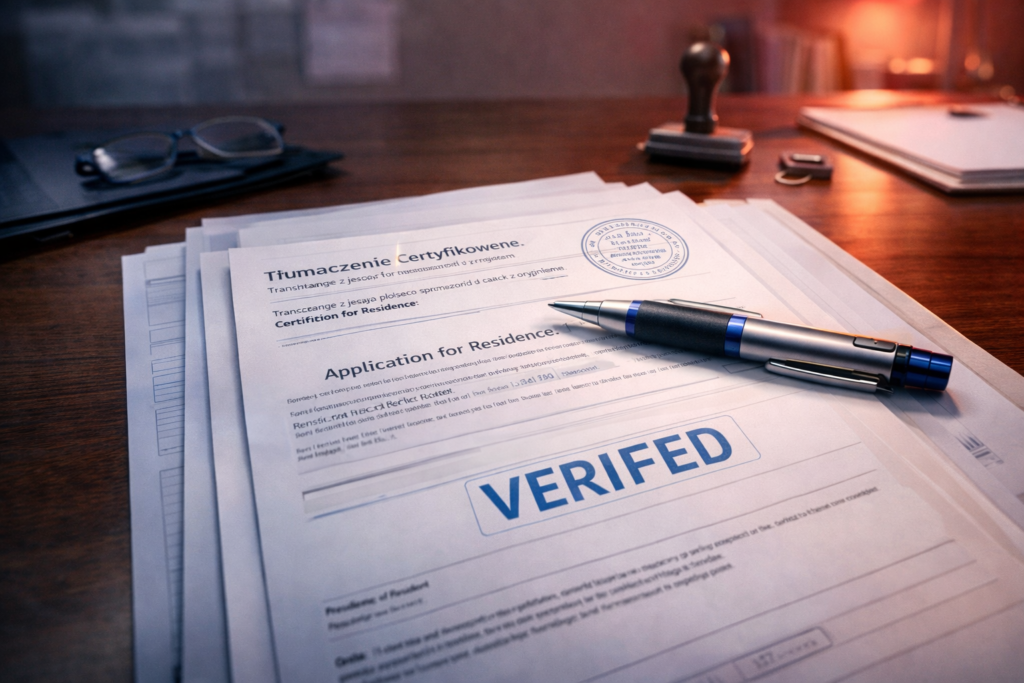
When a sworn translator produces a translation, they attach their personal seal and a signed statement to each page. The translation is recorded in a numbered logbook called a repertorium. Each translation receives a unique reference number. This creates a legal document that carries the same official weight as the original in the eyes of Polish authorities.
Key distinction: A regular translation, even from a professional agency, is by Polish government offices. Only a sworn translator registered with the Ministry of Justice can produce a legally valid translation for official use in Poland.
Polish courts, voivodeship offices, the civil registry office (Urzad Stanu Cywilnego), immigration authorities, the National Labour Inspectorate, and Polish notaries all require sworn translations as the standard for any foreign-language document submitted in an official procedure.
Certified translations, which are common in the UK, the US, and other countries, play no role in the Polish administrative system. They are not requested and not accepted.
Who Needs Sworn Translation for Work-Based Residence in Poland
The short answer is: almost any non-EU foreign national applying for a work-related residence permit. But the full picture depends on your situation. Here are the most common groups.
Non-EU Foreign Workers on a Single Permit
The most common path for non-EU nationals working in Poland is the unified residence and work permit, sometimes called the single permit. This combines the right to live and work in one application. Foreign nationals from countries such as India, Nepal, the Philippines, Vietnam, Georgia, and many others fall into this category.
Your application must include a range of supporting documents, and any document originally issued in a language other than Polish must come with a sworn Polish translation.
Highly Skilled Workers Applying for an EU Blue Card
Poland offers the EU Blue Card to highly qualified non-EU professionals. To qualify in 2026, your monthly gross salary must be at least PLN 12,272.58, and you must hold a higher education degree or three years of relevant documented experience. Your academic diplomas and professional qualifications, if issued in a foreign language, require sworn translation.
Foreign Graduates Transitioning from Student to Work Permit
If you completed your studies outside Poland and are now applying for a work-based residence permit, your foreign diploma and academic transcripts will need sworn translation. Graduates of Polish institutions present their Polish-language documents directly, but those with foreign degrees must have them translated.
Ukrainian Citizens After March 2026
Until early 2026, Ukrainian citizens in Poland benefited from special temporary protection rules. As of March 5, 2026, the general residence permit requirements apply in full to Ukrainian citizens. This means Ukrainian nationals applying for work-based residence must now submit the same sworn translations as other non-EU nationals.
Employers with Foreign-Language Employment Contracts
Since June 2025, Polish law requires that any employment contract written exclusively in a foreign language must have a sworn Polish translation. The employer must keep this translation for the entire duration of employment and for two additional years afterward. For bilingual contracts, such as a Polish and English version, sworn translation is not required.

Step by Step: How the Process Works in 2026
Understanding the process from start to finish will help you plan your timeline and avoid unnecessary delays. Here is how it typically works for a work-based residence permit application in Poland.
- Confirm your eligibility and permit type
Before collecting any documents, identify the correct permit category for your situation. The most common options are the temporary residence and work permit (single permit), the EU Blue Card for high-skilled workers, and seasonal permits for short-term agricultural or tourism work. Each category has its own document checklist.
- Gather your documents
You will need to collect documents from multiple sources, including your employer, your home country, and possibly your university. Any document in a language other than Polish will need a sworn translation.
- Identify which documents need sworn translation
Go through each document and check its language. If it is in a language other than Polish, it requires sworn translation. Common examples include diplomas, birth certificates, criminal record certificates, and foreign employment contracts.
- Contact a sworn translator in Poland
You must use a translator listed on the official Ministry of Justice register. Provide the original document or a clear scan to the translator. They will produce a stamped and signed translation in paper form, recorded in their repertorium with a unique reference number.
- Prepare your complete application file
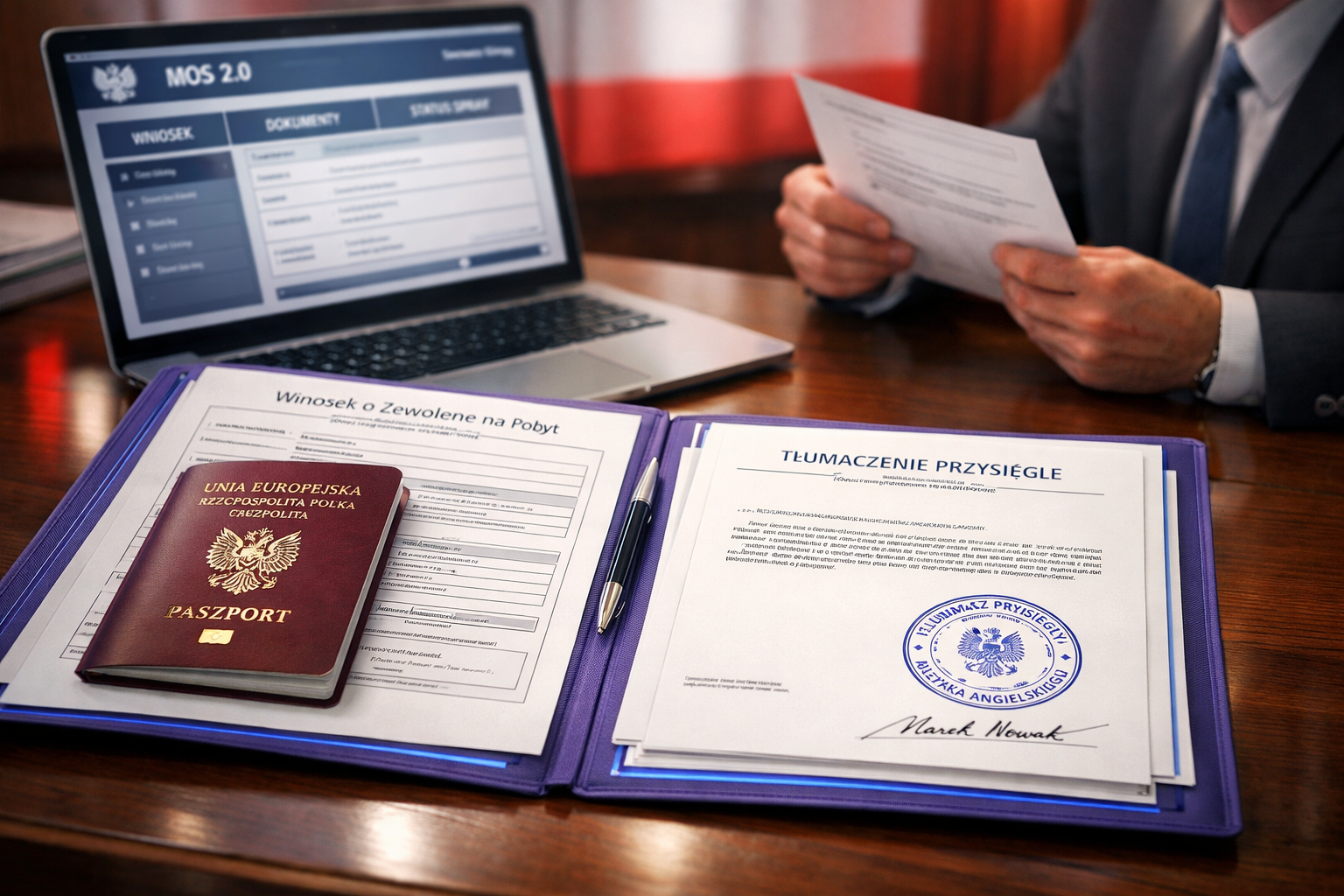
Assemble all documents, translations, completed forms, and employer annexes. Since December 2025, the application form itself has changed, and since April 27, 2026, all applications must be submitted through the MOS 2.0 portal. Paper applications are no longer accepted and will be rejected outright if received after that date.
- Submit through the MOS portal
Create an account on the official MOS portal at mos.cudzoziemcy.gov.pl. Sign your application using a Trusted Profile (Profil Zaufany), EU eID, or a qualified electronic signature. Upload scans of all required documents, including your sworn translations. Your employer must also complete their section electronically within the portal.
Important note: A lawyer or advisor can help you prepare your file, but the final submission must be signed and submitted by you personally. The Trusted Profile is biometric and cannot be delegated.
- Wait for a decision and collect your card
After submission, you will receive a certificate confirming your application is being processed. Your legal stay in Poland continues during this period. In Warsaw (Mazowieckie Voivodeship), processing times for temporary residence permits currently range from 4 to 12 months. You can track your case status through the inPOL Foreigner Portal using the code assigned to you.
Required Documents and What Needs to Be Translated
The exact document list varies depending on your permit category, but the following are commonly required for work-based residence applications. Documents that typically require sworn Polish translation if issued in a foreign language are noted.
Identity and Travel Documents
Valid passport (all completed pages). Previous residence cards or visas if applicable.
Note: Passports themselves do not require sworn translation. However, if your passport contains stamps or endorsements in a non-Latin alphabet, some offices may request a translation of specific entries.
Employment and Work Documents
Employer’s Annex (Zalacznik nr 1) confirming employment details, completed directly in MOS. Employment contract, sworn translation required if issued exclusively in a foreign language. Documents confirming the employer’s legal status and business registration. For regulated professions: professional license or qualifications certificate, sworn translation required if in a foreign language.
Educational and Professional Qualifications
University diploma or degree certificate, sworn translation required. Academic transcripts, sworn translation required. Professional certificates or vocational qualifications, sworn translation required.
For the EU Blue Card specifically, you must demonstrate that your qualifications meet the standard for higher education or that you have documented professional experience of at least three years in a relevant field.
Civil Status and Personal Documents
Birth certificate, sworn translation required. Marriage certificate if applying for family-related components, sworn translation required. Criminal record certificate from your country of origin, sworn translation required.
Financial and Accommodation Documents
Proof of health insurance coverage in Poland. Bank statements or proof of income to demonstrate financial stability. Lease agreement or rental contract confirming your address in Poland. Proof of registered address (meldunek) if required by the specific voivodeship.
Apostille reminder: Some foreign documents, such as criminal record certificates and civil status documents like birth certificates, must also carry an apostille from the issuing country before they can be submitted. The sworn translator translates the document and its apostille together. If your document has no apostille, the voivodeship office may refuse to accept it regardless of the quality of the translation.
Common Mistakes Foreigners Make When Submitting Sworn Translations
Most delays and rejections in Poland’s residence permit process come down to a small number of avoidable errors. Here are the ones that appear most often.
Using a Non-Sworn Translator
This is the most common and most costly mistake. Many foreigners use translation apps, bilingual friends, standard translation agencies, or certified translators from their home country. None of these are Only a translator currently registered on the Ministry of Justice sworn translator list produces a legally valid translation in Poland.
Submitting a Scan of a Sworn Translation
A sworn translation exists as a physical paper document with the translator’s original stamp and signature. A scan of that document has no legal force in Poland. While some offices may accept a scan initially to begin reviewing your case, the original paper translation will always be required for the official file.
Forgetting the Apostille on Foreign Documents
A sworn translation is only as valid as the underlying document. If your birth certificate, criminal record certificate, or another civil document from your home country is not apostilled, the document itself may be considered unverifiable. You need both: the apostille from your country and the sworn translation from a Polish sworn translator.
Ordering Translation from the Wrong Language Pair
Make sure the sworn translator you work with is registered for the specific language pair you need. A sworn translator for English is not automatically authorized to translate Russian documents, or vice versa. The Ministry of Justice list specifies which languages each translator is certified for.
Leaving Translation Too Late
Sworn translations take time, especially for complex documents like academic diplomas with detailed transcripts. Planning ahead is important. Rushing at the last moment can mean a poorly prepared file, which the voivodeship office will use as a reason to request corrections, effectively resetting the processing timeline.
Changing Employers While the Application Is Pending
If you applied for a residence and work permit tied to a specific employer and then change jobs before the decision is issued, you must notify the voivodeship office and submit new employer documentation. This often resets the processing clock, and a new sworn translation of the new contract may also be required.
Assuming the MOS Portal Accepts Any File Format
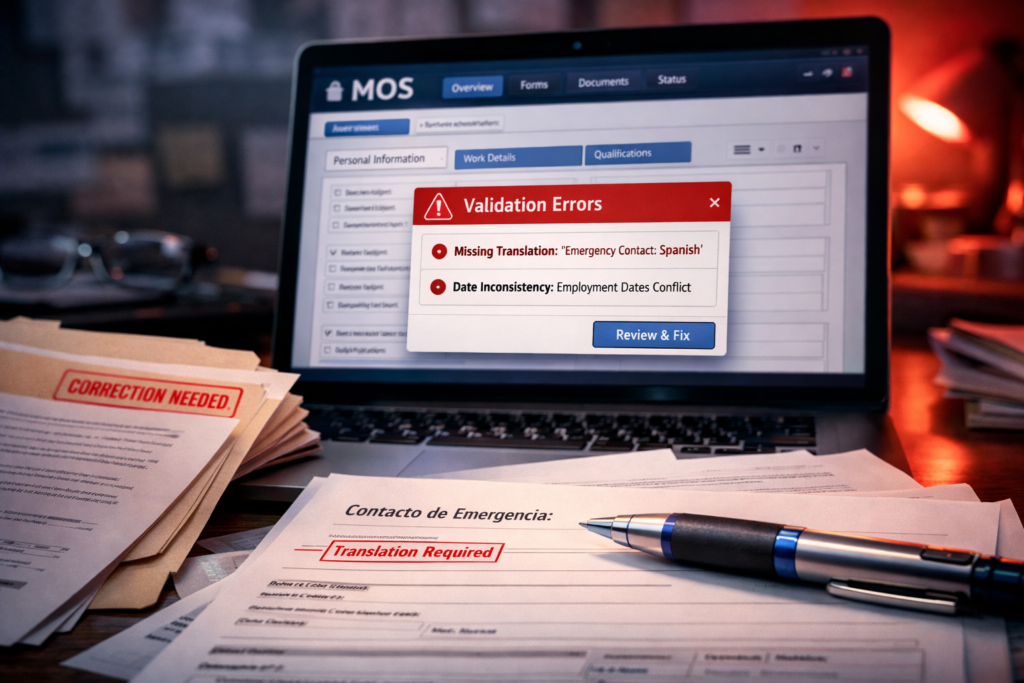
The MOS portal has specific technical requirements for document uploads. Always use clear, well-lit scans at an appropriate resolution. Blurry or incomplete scans of sworn translations will be flagged by the system or by case officers, causing delays.
Conclusion
Applying for a work-based residence permit in Poland is a serious administrative process. The documents you submit are reviewed by officials who follow strict formal rules. A missing translation, an unrecognized translator, or a document without an apostille can delay your permit by months.
The requirements are not designed to make life difficult for foreigners. They exist to ensure that every document is trustworthy and verifiable. Understanding the difference between a sworn translation and a regular translation, knowing which documents need it, and acting early in the process are the three things that will make the biggest difference to your application.
In 2026, with the MOS portal now fully operational, the process is more streamlined than before, but also less forgiving of mistakes. There are no paper submissions to send back and forth. Once you upload your documents electronically, the case moves forward, and any errors become formal deficiencies that require official correction notices.
Plan your translations early, work with a registered sworn translator, keep your original paper documents safe, and follow the checklist relevant to your specific permit category. These steps will give your application the strongest possible foundation.
Frequently Asked Questions
How long does it take to get a sworn translation in Poland?
Most standard documents can be translated within two to five business days. More complex documents such as academic transcripts with many pages, legal judgments, or technical qualification certificates may take longer. If you have an urgent deadline, many sworn translators offer express service for an additional fee. It is always advisable to allow at least one week from the time you contact a translator to when you need the finished document.
Can I use a sworn translation done for a previous application or in a different country?
Not automatically. Sworn translations produced in another country are generally not recognized by Polish authorities unless they meet very specific conditions. If the translation was done by a Polish sworn translator in Poland and the document has not changed, it may still be valid. However, if the translation was done abroad, or if it references outdated information, a new sworn translation will likely be required. Always check with the specific voivodeship office handling your case.
Do EU citizens need sworn translations when applying for residence in Poland?
EU, EEA, and Swiss citizens do not need a work permit to work in Poland and are not subject to the same residence permit procedures as non-EU nationals. However, if an EU citizen applies for formal registration of their stay or for a residence document, and they submit supporting documents in a language other than Polish, sworn translations may still be required depending on the office and the nature of the document.
Is a sworn translation valid forever?
There is no official expiration date on a sworn translation in Poland. However, if the original document has changed or been updated, a new translation of the new document is needed. Additionally, some offices may question the relevance of older translations if the circumstances described in the document are no longer current. For time-sensitive documents such as bank statements, a recent translation is almost always expected.
What happens if my sworn translation is rejected by the office?
If a document or translation is considered formally deficient, the office will issue a notice requesting corrections or additional materials. This formally pauses the processing timeline. You will then need to address the identified issue, which may mean ordering a new sworn translation, obtaining an apostille, or submitting an additional document. This is why getting the translation right before submission is critical: every deficiency notice adds weeks or months to your waiting time.
Contact us Call us+48 514 302 221 Monday – Friday
Email: Biuro@sworntranslatorwarsaw.pl
Officesul. Krucza 16/22 , Lokal- 41100-526 Warszawa