Certified Translation for TRC Applications in Poland: A Complete Step by Step Guide
Introduction
Applying for a Temporary Residence Card in Poland is often one of the most stressful administrative tasks a foreigner faces after arriving in the country. The process involves gathering a large number of documents, meeting strict deadlines, and navigating an office system that operates entirely in Polish.
One of the most common reasons TRC applications get delayed or outright rejected is not missing paperwork. It is paperwork that is submitted in the wrong format. Specifically, many applicants submit foreign language documents without a certified sworn translation, or they submit translations prepared by someone who is not legally authorized to certify them in Poland.
This guide is written for people who are already in Poland or planning to move here, and who want to understand what a sworn translation is, when it is required for a TRC application, and how to get it done correctly the first time.
Whether you are here for work, study, family reunification, or any other reason, this guide will walk you through the process clearly and practically.
What Is a Sworn Translation and Why Does Poland Require It
A sworn translation is a legally certified translation of an official document. In Poland, it can only be produced by a sworn translator (in Polish: tłumacz przysięgły) who has been officially appointed by the Polish Minister of Justice and is listed in the national register of sworn translators.
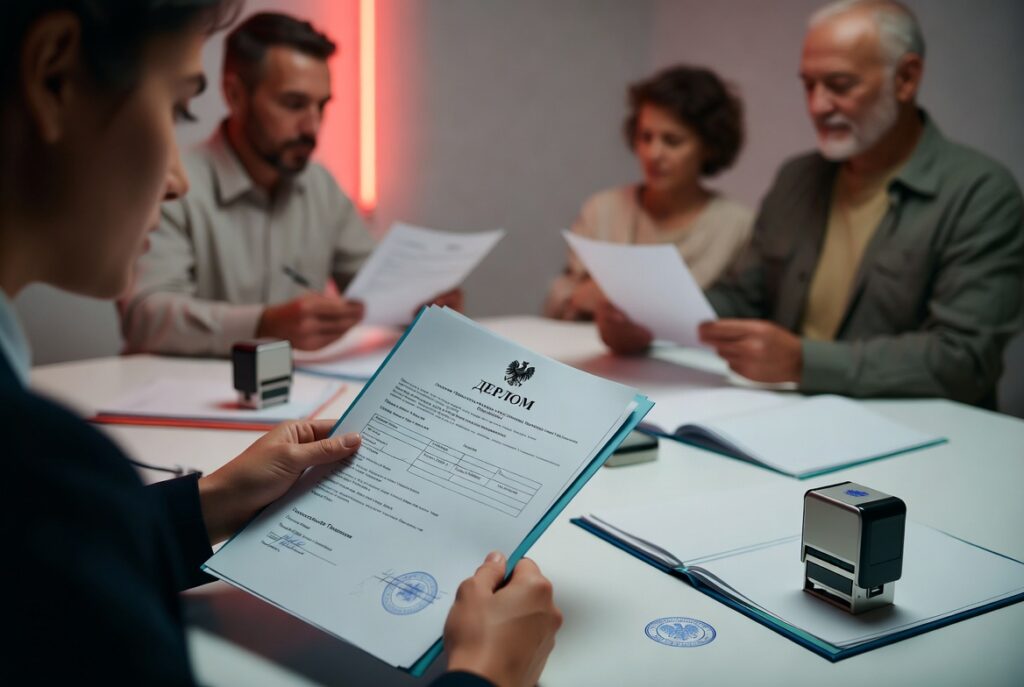
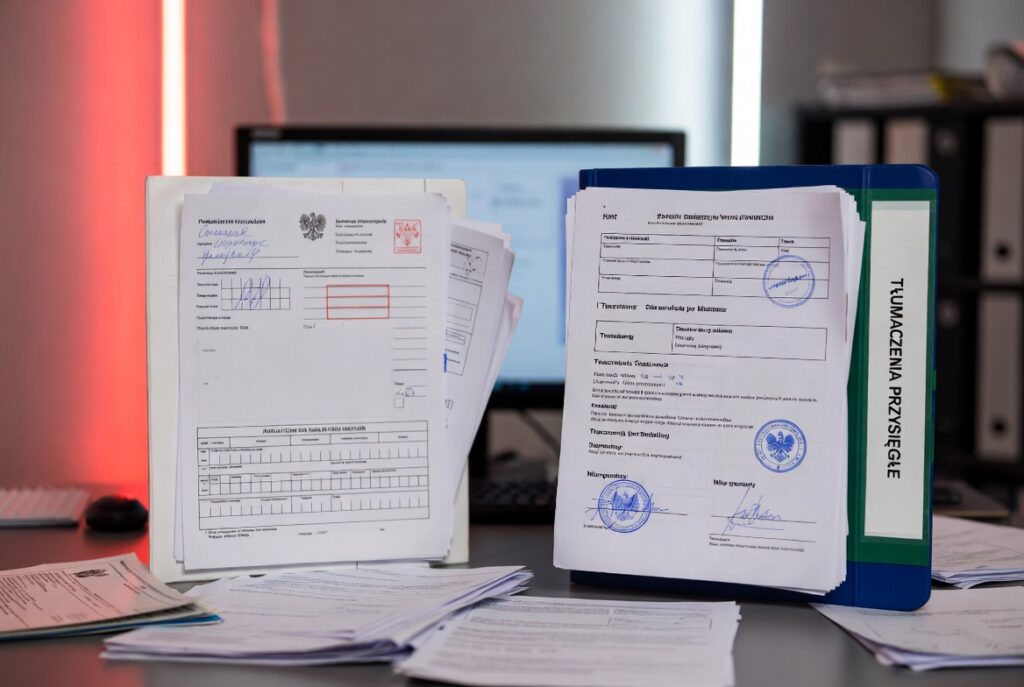
The sworn translator stamps and signs each page of the translation, certifying that the content is a faithful and accurate rendering of the original document. This stamp and signature carry legal weight, which is why Polish government offices, courts, and public institutions require them when processing foreign documents.
Poland’s requirement for sworn translations is based on the principle that official documents submitted to Polish authorities must be verifiable, accurate, and legally accountable. A regular bilingual translation, no matter how skilled the person who prepared it, does not meet this standard for official use.
This matters because a TRC application is a legal procedure handled by the Voivodeship Office (Urząd Wojewódzki). The office reviews your documents against national and EU regulations, and any document in a foreign language that is not accompanied by a valid sworn translation is considered incomplete.
It is also worth noting that sworn translations in Poland are regulated by the Act of 25 November 2004 on the Profession of Sworn Translator (Ustawa o zawodzie tłumacza przysięgłego, Dz.U. 2004 Nr 273 poz. 2702). This law defines who can produce a sworn translation, what the translation must contain, and how the translator is authorized.
Who Needs a Sworn Translation for a TRC Application in Poland
The short answer is: almost every foreigner submitting foreign language documents as part of their TRC application.
Here are the main groups of people who regularly need sworn translations for this process:
- Foreign workers who hold an employment contract or work permit issued outside of Poland. If your employer is based in another country, or if your qualifications were obtained abroad, several supporting documents will need to be translated by a sworn translator.
- International students enrolled at Polish universities. If you are applying for a residence permit based on your studies, your university admission letter, academic transcripts, and any foreign school certificates may require sworn translation depending on where they were issued.
- Expatriates relocating to Poland for family reunification purposes. If you are joining a Polish citizen, an EU citizen living in Poland, or another foreign national with legal residence, documents such as marriage certificates, birth certificates, or family status records issued abroad will almost certainly need to be sworn translated.
- Business owners and self employed individuals who are applying based on economic activity. Foreign business registration documents, contracts, or financial records submitted as supporting evidence may need to be in translated form.
- Applicants whose national documents are in non Latin script languages such as Arabic, Chinese, Georgian, Ukrainian, or Russian. These documents require a sworn translator certified for that specific language pair. In all these cases, the requirement is not optional. The Voivodeship Office will not process documents in a foreign language without a certified translation signed by a sworn translator listed in the official Polish register.
Step by Step: How the Sworn Translation Process Works for TRC Applications
Understanding the sequence of steps will help you plan your application timeline more realistically.
Step 1: Identify Which Documents Need Sworn Translation
Begin by reviewing the complete list of documents required for your specific type of TRC application. The required documents differ depending on your reason for staying in Poland. Common categories include:
A permit for work, a permit for studies, a permit for family reunification, or a permit for other purposes such as voluntary work or religious activities.
For each document that was issued in a foreign language, you will need to determine whether it is an official document that must be sworn translated. In general, any official document issued by a foreign government body, educational institution, or civil registry office will require sworn translation when submitted to Polish authorities.
Step 2: Collect the Original Documents
Before going to a sworn translator, gather the original documents or certified copies. The sworn translator needs to see the original or a formally certified copy in order to produce a legally valid translation. You cannot simply send a photo on your phone and request a sworn translation of it.
If you are missing certain documents, such as a birth certificate or a criminal record clearance from your home country, contact the relevant authorities in your country well in advance. These documents can take weeks or even months to obtain.
Step 3: Contact a Sworn Translator
Find a sworn translator who is registered in the official Polish register for your language pair. For example, if your documents are in Arabic, you need a sworn translator of Arabic into Polish. If they are in Ukrainian, you need a sworn translator of Ukrainian into Polish.
You can check the official register of sworn translators maintained by the Polish Ministry of Justice at the address: https://arch-bip.ms.gov.pl/pl/rejestry-i-ewidencje/tlumacze-przysiegli/lista-tlumaczy-przysieglych/
When you contact the translator, provide a clear copy or scan of each document so they can give you an accurate quote and timeline. For urgent applications, ask about express service availability.
Step 4: Review the Translation Before Submission
Once you receive the sworn translation, review it together with the original document to confirm that names, dates, places, and document numbers are accurately rendered. Pay particular attention to name spellings, as even small discrepancies between your translated document and your identity document can cause issues during verification.
The sworn translation will be stamped on each page and signed by the translator. It will also include a certification statement and the translator’s registration number. Keep this information for your records.
Step 5: Prepare Your Full Application Package
Assemble all required documents along with their sworn translations. In most cases, the Voivodeship Office will want to see both the original foreign language document and its sworn translation together. Do not remove staples, stamps, or attachments from the original documents.
Make copies of everything before submission. The originals are sometimes kept by the office or returned at a later date.
Step 6: Submit Your Application at the Voivodeship Office
TRC applications must be submitted in person at the Voivodeship Office (Urząd Wojewódzki) that covers the area where you are registered as residing. As of 2024, most Voivodeship Offices require you to book an appointment in advance, and some have separate windows for foreigners.
Bring a valid passport or identity document to your appointment. If you are submitting for a family member, bring documentation confirming your right to act on their behalf.
After submission, you will receive a stamp in your passport confirming that your application has been submitted and is under review. This stamp allows you to remain legally in Poland while your application is being processed.
Step 7: Respond to Any Additional Requests
Polish Voivodeship Offices often issue a formal request for supplementary documents during the review period. This is a normal part of the process. You will receive an official letter (in Polish) asking you to provide additional materials within a set deadline.
If you receive such a letter, act quickly. Missing the deadline can result in your application being closed.
Required Documents: What Typically Needs a Sworn Translation
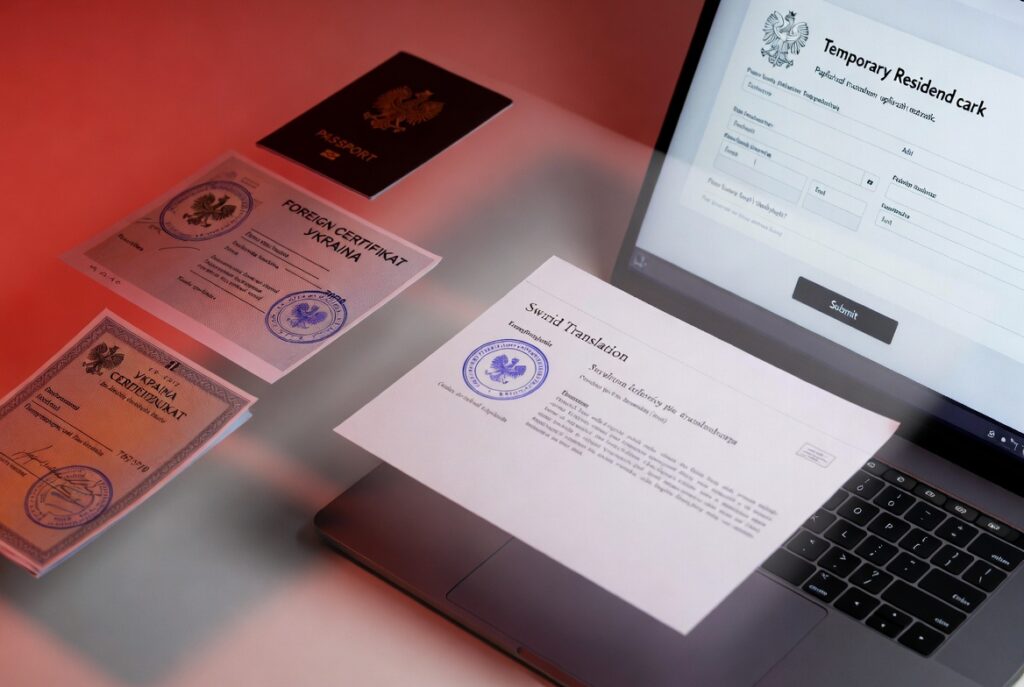
The exact list varies by application type, but the following documents are among the most commonly required in TRC applications and often need sworn translation when issued in a foreign language.
- Civil registry documents such as birth certificates, marriage certificates, and divorce decrees. These are almost always required when applying on the basis of family ties or family reunification.
- Criminal record clearances from your country of origin or country of previous residence. Many application types require proof that you have no criminal record. If this document is issued in a foreign language, a sworn translation is required.
- Educational diplomas and certificates when the purpose of your stay is connected to employment that requires specific qualifications. A foreign degree or professional certification submitted as supporting evidence needs to be sworn translated.
- Employment contracts and employer declarations issued by a foreign employer. If your employer is outside Poland and provides documentation supporting your residence application, that documentation will need sworn translation.
- Company registration documents for applicants applying on the basis of running a business in Poland. If your company is registered in another country, foreign registration documents will need to be translated.
- Medical documents in some cases, such as proof of health insurance coverage issued by a foreign insurer or foreign medical records where required.
- School enrollment confirmations for international students who have been accepted to study in Poland but whose initial acceptance documentation was issued in a foreign language or by a foreign institution. Always verify the exact requirements with the specific Voivodeship Office where you will be submitting your application, as requirements can vary slightly between offices and are updated from time to time.
Common Mistakes Foreigners Make with Sworn Translations in TRC Applications
Even well prepared applicants sometimes make mistakes that cause delays of months. Here are the most frequent errors and how to avoid them.
. Many people confuse a regular translation with a sworn translation. A bilingual friend, a freelance translator, or a translation agency can produce a high-quality translation, but it will not be accepted by the Voivodeship Office unless it is produced and signed by a Polish sworn translator who is listed in the official register. Always verify the translator’s status before commissioning work.
Choosing the wrong language pair. A sworn translator is certified for a specific language pair. A translator certified for English to Polish cannot legally produce a sworn translation from Ukrainian to Polish. Make sure the translator you hire holds a license for the exact language pair you need.
Submitting poor quality photocopies for translation. The sworn translator must be able to read the original document clearly. If you provide a blurry scan or an incomplete copy, the translator cannot guarantee accuracy, and the resulting translation may be questioned. Provide clean, full sized copies of the originals.
Translating only part of the document. A sworn translation must cover the entire document, including all stamps, signatures, headers, footers, and official markings. Translating only the main text while omitting official seals or annotations is not acceptable for official use.
Waiting too long to start. Getting your original documents from abroad, waiting for them to arrive by mail, finding an available sworn translator, and then preparing the full application package takes time. Many applicants underestimate how long this process takes and find themselves scrambling close to their visa or permit expiry date. Start early. Ideally, begin gathering documents and translations at least four to six weeks before your application deadline.
Not checking the translator’s registration number. The sworn translation must include the translator’s registration number from the Polish Ministry of Justice. If this number is absent, the document may be rejected. Before submitting, confirm that the translation includes this number and that it matches the information in the official register.
Assuming digital translations are sufficient. Polish Voivodeship Offices generally require physical sworn translations with ink stamps and original signatures. Scanned or digital versions are not accepted as a substitute unless the office specifically provides for electronic submission. Always confirm the format requirements with the office in advance.
Neglecting apostilles or legalization. If your original document was issued in a country that requires it, you may also need an apostille or formal legalization before the sworn translation is accepted. An apostille is a certification that validates the authenticity of the document for international use. Documents from countries that are not signatories to the Hague Apostille Convention of 1961 may require full consular legalization instead. This is a separate step from the translation itself, but it is often necessary.
Conclusion
Applying for a Temporary Residence Card in Poland requires careful preparation, and the sworn translation of your foreign language documents is one of the most important and legally non negotiable parts of that preparation. Polish law requires that official documents submitted to government offices in a language other than Polish be accompanied by a certified sworn translation produced by a translator registered with the Polish Ministry of Justice.
The good news is that once you understand which documents need to be translated, how the process works, and what common errors to avoid, the task becomes much more manageable. Planning ahead, using a registered sworn translator, and submitting complete and correctly formatted translations will significantly reduce the risk of delays or rejections.
A TRC application is an investment in your ability to live and work legally in Poland. The translation step is a small but critical part of that investment. Do it right the first time.
Need a Sworn Translation in Warsaw? Sworn Translator Warsaw Is Ready to Help
If you are preparing a TRC application and need certified sworn translations of your foreign language documents, Sworn Translator Warsaw provides professional sworn translation services for legal and official use in Poland.
The team works with a wide range of language pairs and document types, including birth certificates, marriage certificates, diplomas, employment documents, criminal record clearances, and more.
All translations are produced by registered sworn translators listed in the official Polish Ministry of Justice register, and every translation is correctly formatted for submission to Polish government offices, including Voivodeship Offices handling residence permit applications.
Getting your translations right from the start saves time, avoids costly resubmissions, and keeps your application on track.
Contact Sworn Translator Warsaw today to ask about your specific documents and receive information about timelines and service options.
Frequently Asked Questions
How long does a sworn translation take in Poland?
The time varies depending on the length and complexity of the document and on the translator’s current workload. For standard documents such as birth certificates, marriage certificates, or single page diplomas, a turnaround of two to five business days is common. For longer documents or during busy periods, the process can take longer. Express services are available from many sworn translators for an additional fee if you are working against a deadline.
Can I use a sworn translation that was produced in another country?
Poland generally requires sworn translations to be produced by a translator who is registered in the Polish system, regardless of what country the original document comes from. A sworn translation produced by a certified translator in Germany or France, for example, will typically not be accepted by a Polish Voivodeship Office. If you already have translations in another language, a Polish sworn translator can work from those translations together with the original source document, but you will still need a Polish sworn translation produced according to Polish legal requirements.
Does my Polish employer need to provide sworn translations of work documents?
If your Polish employer is providing documents in Polish, those documents do not require translation. However, if any supporting document related to your employment was issued by a foreign entity or in a foreign language, that document will need sworn translation before submission. In practice, most employment related documents for TRC applications based on work in Poland are generated by the Polish employer or the Polish labor authority, so they are already in Polish.
Is a sworn translation valid permanently or does it expire?
The sworn translation document itself does not carry an expiry date. However, the underlying original document may have limited validity. For example, a criminal record clearance certificate is typically only valid for a certain period after issue, often three to six months. This means you may need to obtain a fresh original and a new sworn translation if your original has expired before you submit your application. Always check the validity requirements for each specific document type.
What happens if I submit my application with an unsigned or incorrectly formatted sworn translation?
The Voivodeship Office will issue a formal request asking you to correct the deficiency, and your application timeline will be extended accordingly. In some cases, if you do not respond within the given deadline, the application can be rejected on formal grounds. This is why it is important to review the sworn translation carefully before submitting and to work with a translator who understands the requirements of Polish immigration authorities.
Contact us Call us+48 514 302 221 Monday – Friday
Email: Biuro@sworntranslatorwarsaw.pl
Officesul. Krucza 16/22 , Lokal- 41100-526 Warszawa